Introduction
This post provides a comprehensive walkthrough of designing a distributed job scheduler system, a common interview question at fintech companies. We’ll design a system that can handle millions of jobs, ensure reliable execution, and scale horizontally to meet requirements for financial operations.
Table of Contents
- Problem Statement
- Requirements
- Capacity Estimation
- Core Entities
- API
- Data Flow
- Database Design
- High-Level Design
- Deep Dive
- Conclusion
Problem Statement
Build a service/system that can support defining and running jobs on a schedule. Requirements:
-
Should be able to create jobs: Users can create/define jobs via an API with execution commands, required resources, priority, schedule, and other configuration.
-
Should be able to schedule and run jobs: The system must efficiently schedule jobs and execute them according to their schedule, priority, and resource availability.
-
Should be able to report failures and successes: The system must track and report job execution outcomes (success/failure), with detailed failure reasons and success metrics.
- Should be reliable and have strong guarantees about its job runs: The system must provide strong guarantees:
- At-least-once execution: Jobs will execute at least once (may execute multiple times for retries)
- Exactly-once semantics where possible: For idempotent jobs
- No job loss: Jobs are never lost, even during system failures
- Guaranteed execution: Scheduled jobs will execute if resources are available
- Atomic operations: Job state transitions are atomic
- Should be able to view logs and status of running jobs, as well as previously finished jobs: Provide comprehensive interfaces to:
- View real-time status of running jobs
- Access execution logs (stdout, stderr)
- View historical job executions
- Query job status and history
- Should be able to handle when a job takes longer to run than expected (SLA): The system must handle SLA violations:
- Detect when jobs exceed their expected execution time
- Take appropriate actions (timeout, kill, alert, extend)
- Track SLA compliance metrics
- Support configurable SLA policies
Describe the system architecture, including components and technology choices, considering system scalability and reliability.
Requirements
Functional Requirements
Core Features:
- Create Jobs (Job Definition)
- Create jobs via REST API with complete job definition
- Job metadata: command, resources (CPU, memory), priority, schedule, timeout, retry policy
- Support different job types: one-time, recurring, scheduled, cron-based
- Job dependencies (Job B runs after Job A completes)
- Job configuration and environment variables
- Validation of job definitions before creation
- Schedule and Run Jobs
- Schedule jobs based on time (cron, interval, specific time)
- Priority-based scheduling (higher priority jobs run first)
- Resource-aware scheduling (match jobs to available resources)
- Fair scheduling (prevent starvation, ensure fairness)
- Support different scheduling algorithms (FIFO, priority queue, fair share)
- Handle job dependencies before execution
- Report Failures and Successes
- Track job execution outcomes (success/failure)
- Detailed failure reporting: error codes, error messages, stack traces
- Success metrics: execution time, resource usage, output size
- Failure classification: transient vs. permanent errors
- Failure aggregation and reporting
- Success/failure rate tracking per job, user, team
- Reliability and Strong Guarantees
- At-least-once execution: Jobs execute at least once (may retry)
- Exactly-once semantics: For idempotent jobs with idempotency keys
- No job loss guarantee: Jobs persisted to database, never lost
- Guaranteed execution: Scheduled jobs will execute if resources available
- Atomic state transitions: Job status changes are atomic
- Durability: All job definitions and executions persisted
- Consistency: Strong consistency for job metadata
- Transaction support: Critical operations use transactions
- View Logs and Status
- Real-time status of running jobs (queued, scheduled, running, completed, failed)
- Execution logs: stdout, stderr with real-time streaming
- Job history: all previous executions with status
- Execution details: start time, end time, duration, resource usage
- Log search and filtering capabilities
- Log retention and archival policies
- Handle SLA Violations (Long-Running Jobs)
- SLA definition: expected execution time per job
- SLA monitoring: track execution time vs. expected time
- SLA violation detection: alert when job exceeds SLA
- SLA violation handling:
- Timeout and kill jobs that exceed max execution time
- Alert on SLA violations
- Extend SLA for long-running jobs (with approval)
- Track SLA compliance metrics
- Support for configurable SLA policies (strict, flexible, warning-only)
- Additional Features
- Job cancellation and pause/resume
- Resource quota management
- Worker node failure handling
- Horizontal scaling of all components
Non-Functional Requirements
Scale:
- 10+ million jobs per day
- 100,000+ concurrent jobs
- Thousands of worker nodes
- Millions of users
Performance:
- Job submission latency: < 100ms
- Job scheduling latency: < 50ms
- Job status query latency: < 50ms
- 99.9% jobs scheduled within 1 second
Reliability:
- 99.99% uptime
- No job loss guarantee
- At-least-once execution guarantee (exactly-once for idempotent jobs)
- Strong consistency for job metadata
- Atomic state transitions
- Automatic failover
- Data durability (all writes persisted)
Availability:
- Multi-region deployment
- No single point of failure
- Graceful degradation
Financial Compliance:
- Complete audit trail
- Job execution logs retention
- Security and access control
Clarifying Questions
Scale:
- Q: What’s the expected number of jobs per day?
- A: 10+ million jobs per day, with peaks up to 100,000 jobs per minute
Resources:
- Q: What types of resources need to be managed?
- A: CPU cores, memory (GB), disk space, GPU (optional), network bandwidth
Job Types:
- Q: What types of jobs need to be supported?
- A: Batch jobs, real-time jobs, scheduled jobs, recurring jobs
Priority:
- Q: How many priority levels?
- A: 0-1000, with 1000 being highest priority
Execution Environment:
- Q: What execution environments?
- A: Docker containers, Kubernetes pods, VMs
Retry Policy:
- Q: What retry strategies?
- A: Exponential backoff, max retries, retry on specific error types
Dependencies:
- Q: Do jobs have dependencies?
- A: Yes, support job dependencies (Job B depends on Job A)
Capacity Estimation
Storage Estimates
Job Metadata:
- Each job: ~2KB metadata
- 10M jobs/day × 2KB = 20GB/day
- With 30-day retention: ~600GB
- With 1-year retention: ~7.3TB
Job Execution Logs:
- Each execution: ~10KB logs
- 10M jobs/day × 10KB = 100GB/day
- With 30-day retention: ~3TB
- With 1-year retention: ~36.5TB
Job Status Updates:
- Each status update: ~500 bytes
- 10M jobs × 5 status updates = 50M updates/day
- 50M × 500 bytes = 25GB/day
Throughput Estimates
Write QPS:
- Job submissions: 100,000 jobs/minute = ~1,667 QPS
- Status updates: 50M updates/day = ~580 QPS
- Total writes: ~2,250 QPS
Read QPS:
- Job status queries: 500,000 QPS (users checking status)
- Job history queries: 100,000 QPS
- Total reads: ~600,000 QPS
Execution QPS:
- Job executions: 100,000 jobs/minute = ~1,667 QPS
Network Bandwidth
- Job submissions: 1,667 QPS × 2KB = 3.3MB/s
- Status updates: 580 QPS × 500 bytes = 290KB/s
- Job queries: 600,000 QPS × 1KB = 600MB/s
- Total: ~600MB/s
Resource Capacity
Worker Nodes:
- 1,000 worker nodes
- Each node: 32 CPU cores, 128GB RAM
- Total: 32,000 CPU cores, 128TB RAM
Database:
- Need to handle 2,250 write QPS and 600,000 read QPS
- Requires sharding and read replicas
Core Entities
Job
- Attributes: job_id, job_name, job_type, command, resources, priority, schedule, status, created_at, updated_at
- Relationships: Has executions, has dependencies, belongs to user/team
Job Execution
- Attributes: execution_id, job_id, worker_node_id, status, started_at, completed_at, exit_code, logs_url
- Relationships: Belongs to job, runs on worker node
Worker Node
- Attributes: worker_id, hostname, ip_address, available_resources, status, last_heartbeat
- Relationships: Executes jobs, reports status
Schedule
- Attributes: schedule_id, job_id, cron_expression, timezone, next_run_time, enabled
- Relationships: Belongs to job
API
Job Submission
POST /api/v1/jobs
Authorization: Bearer {token}

Request:
{
  "job_name": "portfolio_rebalancing",
  "job_type": "batch",
  "command": "python /app/scripts/rebalance.py",
  "execution_env": "docker",
  "resources": {
    "cpu_cores": 4,
    "memory_gb": 8,
    "disk_gb": 10
  },
  "scheduling": {
    "priority": 750,
    "max_execution_time": 3600
  },
  "retry": {
    "max_retries": 3,
    "retry_policy": "exponential_backoff"
  }
}

Response: 201 Created
{
  "job_id": "550e8400-e29b-41d4-a716-446655440000",
  "status": "queued",
  "created_at": "2025-11-03T10:00:00Z",
  "estimated_start_time": "2025-11-03T10:00:05Z"
}
Get Job Status
GET /api/v1/jobs/{job_id}

Response: 200 OK
{
  "job_id": "550e8400-e29b-41d4-a716-446655440000",
  "status": "running",
  "created_at": "2025-11-03T10:00:00Z",
  "started_at": "2025-11-03T10:00:05Z",
  "current_execution": {
    "execution_id": "exec-uuid",
    "worker_node_id": "worker-123",
    "status": "running",
    "started_at": "2025-11-03T10:00:05Z"
  },
  "retry_count": 0
}
Cancel Job
DELETE /api/v1/jobs/{job_id}

Response: 200 OK
{
  "job_id": "550e8400-e29b-41d4-a716-446655440000",
  "status": "cancelled",
  "cancelled_at": "2025-11-03T10:05:00Z"
}
List Jobs
GET /api/v1/jobs?status=running&limit=100&offset=0

Response: 200 OK
{
  "jobs": [
    {
      "job_id": "uuid-1",
      "job_name": "job-1",
      "status": "running",
      "created_at": "2025-11-03T10:00:00Z"
    }
  ],
  "total": 1500,
  "limit": 100,
  "offset": 0
}
Data Flow
Job Submission Flow
- Client submits job → API Gateway
- API Gateway → Job Submission Service
- Job Submission Service validates job definition
- Job Submission Service → Database (store job)
- Job Submission Service → Message Queue (job created event)
- Message Queue → Scheduler Service (trigger scheduling)
- Response returned to client
Job Scheduling Flow
- Scheduler Service polls for jobs to schedule
- Scheduler Service checks job dependencies
- Scheduler Service matches job to available worker
- Scheduler Service → Database (update job status to “scheduled”)
- Scheduler Service → Message Queue (job scheduled event)
- Message Queue → Executor Service (execute job)
Job Execution Flow
- Executor Service receives job execution request
- Executor Service → Worker Node (dispatch job)
- Worker Node executes job
- Worker Node → Log Storage (stream logs)
- Worker Node → Executor Service (status updates)
- Executor Service → Database (update execution status)
- Executor Service → Message Queue (execution completed event)
Database Design
Schema Design
Jobs Table:
CREATE TABLE jobs (
    job_id VARCHAR(36) PRIMARY KEY,
    job_name VARCHAR(255) NOT NULL,
    job_type ENUM('batch', 'streaming', 'scheduled') NOT NULL,
    command TEXT NOT NULL,
    execution_env VARCHAR(50),
    resources JSON,
    priority INT DEFAULT 500,
    status ENUM('queued', 'scheduled', 'running', 'completed', 'failed', 'cancelled') DEFAULT 'queued',
    user_id VARCHAR(36),
    team_id VARCHAR(36),
    created_at TIMESTAMP,
    updated_at TIMESTAMP,
    INDEX idx_status_priority (status, priority DESC),
    INDEX idx_user_id (user_id),
    INDEX idx_created_at (created_at)
);
Job Executions Table:
CREATE TABLE job_executions (
    execution_id VARCHAR(36) PRIMARY KEY,
    job_id VARCHAR(36) NOT NULL,
    worker_node_id VARCHAR(36),
    status ENUM('running', 'completed', 'failed', 'cancelled') NOT NULL,
    started_at TIMESTAMP,
    completed_at TIMESTAMP,
    exit_code INT,
    logs_url VARCHAR(512),
    resource_usage JSON,
    FOREIGN KEY (job_id) REFERENCES jobs(job_id),
    INDEX idx_job_id (job_id),
    INDEX idx_status (status),
    INDEX idx_started_at (started_at)
);
Worker Nodes Table:
CREATE TABLE worker_nodes (
    worker_id VARCHAR(36) PRIMARY KEY,
    hostname VARCHAR(255) NOT NULL,
    ip_address VARCHAR(45),
    available_resources JSON,
    status ENUM('active', 'inactive', 'draining') DEFAULT 'active',
    last_heartbeat TIMESTAMP,
    INDEX idx_status (status),
    INDEX idx_last_heartbeat (last_heartbeat)
);
Job Schedules Table:
CREATE TABLE job_schedules (
    schedule_id VARCHAR(36) PRIMARY KEY,
    job_id VARCHAR(36) NOT NULL,
    cron_expression VARCHAR(255),
    timezone VARCHAR(50),
    next_run_time TIMESTAMP,
    enabled BOOLEAN DEFAULT TRUE,
    FOREIGN KEY (job_id) REFERENCES jobs(job_id),
    INDEX idx_next_run_time (next_run_time),
    INDEX idx_enabled (enabled)
);
Database Sharding Strategy
Shard by Job ID:
- Use consistent hashing to distribute jobs across shards
- Job data and executions on same shard for locality
- Enables efficient job queries
High-Level Design
System Components
┌─────────────────────────────────────────────────────────────┐
│                    Client Applications                       │
│  (Trading System, Portfolio Service, Analytics Service)      │
└──────────────────────┬──────────────────────────────────────┘
                       │
                       ▼
┌─────────────────────────────────────────────────────────────┐
│                    API Gateway                                │
│              (Authentication, Rate Limiting, Load Balance)   │
└──────────────────────┬──────────────────────────────────────┘
                       │
        ┌──────────────┼──────────────┐
        ▼              ▼              ▼
┌──────────────┐ ┌──────────────┐ ┌──────────────┐
│   Job        │ │  Scheduler   │ │  Executor    │
│  Submission  │ │   Service    │ │   Service    │
│   Service    │ │              │ │              │
└──────────────┘ └──────────────┘ └──────────────┘
        │              │              │
        │              │              │
        ▼              ▼              ▼
┌─────────────────────────────────────────────────────────────┐
│                    Data Layer                                 │
│  ┌──────────────┐  ┌──────────────┐  ┌──────────────┐      │
│  │   Database   │  │  Message     │  │   Cache      │      │
│  │ (PostgreSQL) │  │  Queue       │  │   (Redis)    │      │
│  │              │  │  (Kafka)     │  │              │      │
│  └──────────────┘  └──────────────┘  └──────────────┘      │
└──────────────────────┬──────────────────────────────────────┘
                       │
                       ▼
┌─────────────────────────────────────────────────────────────┐
│                    Worker Cluster                             │
│  ┌──────────────┐  ┌──────────────┐  ┌──────────────┐      │
│  │   Worker     │  │   Worker     │  │   Worker     │      │
│  │   Node 1     │  │   Node 2     │  │   Node N     │      │
│  │              │  │              │  │              │      │
│  └──────────────┘  └──────────────┘  └──────────────┘      │
└─────────────────────────────────────────────────────────────┘
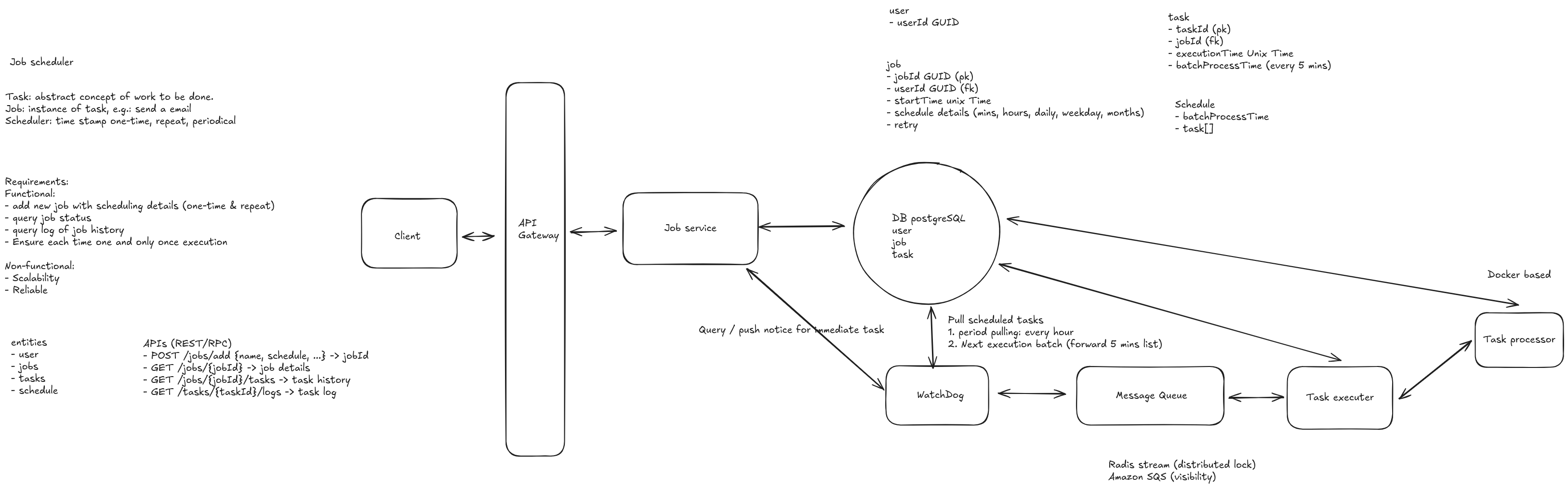
Core Services
- API Gateway: Handles client requests, authentication, rate limiting
- Job Submission Service: Accepts job submissions, validates, stores metadata
- Scheduler Service: Determines when and where to execute jobs
- Executor Service: Manages job execution on worker nodes
- Monitoring Service: Tracks job status, metrics, and alerts
- Resource Manager: Manages worker node resources and allocation
Data Stores
- Database (PostgreSQL): Job metadata, execution history, resource allocation
- Message Queue (Kafka): Async job processing, event streaming
- Cache (Redis): Job status, recent executions, worker node metadata
- Object Storage (S3): Job logs, large outputs
Deep Dive
Component Design
Detailed Design
Database Schema
Jobs Table:
CREATE TABLE jobs (
    job_id UUID PRIMARY KEY,
    user_id UUID NOT NULL,
    job_name VARCHAR(255),
    job_type VARCHAR(50) NOT NULL, -- 'batch', 'realtime', 'scheduled', 'recurring'
    command TEXT NOT NULL,
    execution_env VARCHAR(50), -- 'docker', 'kubernetes', 'vm'

    -- Resources
    cpu_cores INTEGER NOT NULL,
    memory_gb INTEGER NOT NULL,
    disk_gb INTEGER,
    gpu_count INTEGER DEFAULT 0,

    -- Scheduling
    priority INTEGER DEFAULT 500, -- 0-1000
    max_execution_time INTEGER, -- seconds (hard limit)
    expected_execution_time INTEGER, -- seconds (warning threshold)
    timeout_seconds INTEGER,
    sla_policy VARCHAR(20) DEFAULT 'flexible', -- 'strict', 'flexible', 'warning_only'

    -- Retry
    max_retries INTEGER DEFAULT 3,
    retry_policy VARCHAR(50), -- 'exponential_backoff', 'fixed', 'immediate'
    retry_delay_seconds INTEGER DEFAULT 60,

    -- Status
    status VARCHAR(20) DEFAULT 'queued', -- 'queued', 'scheduled', 'running', 'completed', 'failed', 'cancelled'

    -- Timing
    created_at TIMESTAMP NOT NULL,
    scheduled_at TIMESTAMP,
    started_at TIMESTAMP,
    completed_at TIMESTAMP,
    next_retry_at TIMESTAMP,

    -- Metadata
    job_config JSONB,
    tags JSONB,

    -- Indexes
    INDEX idx_status_priority (status, priority DESC, created_at),
    INDEX idx_user_id (user_id),
    INDEX idx_scheduled_at (scheduled_at),
    INDEX idx_next_retry_at (next_retry_at)
);
Job Executions Table:
CREATE TABLE job_executions (
    execution_id UUID PRIMARY KEY,
    job_id UUID REFERENCES jobs(job_id),
    worker_node_id VARCHAR(255),

    -- Execution details
    status VARCHAR(20) NOT NULL, -- 'running', 'completed', 'failed', 'cancelled', 'timeout'
    exit_code INTEGER,
    error_message TEXT,
    error_type VARCHAR(50), -- 'timeout', 'out_of_memory', 'network_error', etc.
    stack_trace TEXT,

    -- Timing
    started_at TIMESTAMP NOT NULL,
    completed_at TIMESTAMP,
    duration_ms INTEGER,

    -- SLA
    expected_execution_time_ms INTEGER,
    max_execution_time_ms INTEGER,
    sla_met BOOLEAN,
    sla_violation_percentage DECIMAL(5,2),

    -- Resources
    cpu_cores_used INTEGER,
    memory_gb_used INTEGER,
    disk_gb_used INTEGER,

    -- Output
    output_size_bytes BIGINT,

    -- Logs
    stdout_log_url TEXT,
    stderr_log_url TEXT,
    log_stream_url TEXT,

    -- Retry info
    retry_count INTEGER DEFAULT 0,

    INDEX idx_job_id (job_id),
    INDEX idx_worker_node_id (worker_node_id),
    INDEX idx_started_at (started_at),
    INDEX idx_status (status),
    INDEX idx_sla_met (sla_met)
);
SLA Events Table:
CREATE TABLE sla_events (
    event_id UUID PRIMARY KEY,
    job_id UUID REFERENCES jobs(job_id),
    execution_id UUID REFERENCES job_executions(execution_id),

    event_type VARCHAR(20) NOT NULL, -- 'sla_warning', 'sla_violation'
    expected_time_ms INTEGER NOT NULL,
    actual_time_ms INTEGER NOT NULL,
    overrun_ms INTEGER,

    action_taken VARCHAR(50), -- 'alert', 'kill', 'extend', 'none'

    timestamp TIMESTAMP NOT NULL,

    INDEX idx_job_id (job_id),
    INDEX idx_execution_id (execution_id),
    INDEX idx_timestamp (timestamp)
);
Job Dependencies Table:
CREATE TABLE job_dependencies (
    job_id UUID REFERENCES jobs(job_id),
    depends_on_job_id UUID REFERENCES jobs(job_id),
    dependency_type VARCHAR(20), -- 'completion', 'success', 'failure'
    PRIMARY KEY (job_id, depends_on_job_id)
);
Worker Nodes Table:
CREATE TABLE worker_nodes (
    node_id VARCHAR(255) PRIMARY KEY,
    node_type VARCHAR(50), -- 'docker', 'kubernetes', 'vm'

    -- Resources
    total_cpu_cores INTEGER NOT NULL,
    total_memory_gb INTEGER NOT NULL,
    total_disk_gb INTEGER,
    total_gpu_count INTEGER DEFAULT 0,

    -- Available resources
    available_cpu_cores INTEGER NOT NULL,
    available_memory_gb INTEGER NOT NULL,
    available_disk_gb INTEGER,
    available_gpu_count INTEGER DEFAULT 0,

    -- Status
    status VARCHAR(20) DEFAULT 'active', -- 'active', 'draining', 'inactive'
    health_status VARCHAR(20) DEFAULT 'healthy', -- 'healthy', 'unhealthy', 'degraded'

    -- Location
    region VARCHAR(50),
    zone VARCHAR(50),

    -- Metadata
    last_heartbeat TIMESTAMP NOT NULL,
    created_at TIMESTAMP NOT NULL,
    updated_at TIMESTAMP NOT NULL,

    INDEX idx_status_health (status, health_status),
    INDEX idx_available_resources (available_cpu_cores, available_memory_gb)
);
Resource Allocations Table:
CREATE TABLE resource_allocations (
    allocation_id UUID PRIMARY KEY,
    job_id UUID REFERENCES jobs(job_id),
    execution_id UUID REFERENCES job_executions(execution_id),
    worker_node_id VARCHAR(255) REFERENCES worker_nodes(node_id),

    cpu_cores INTEGER NOT NULL,
    memory_gb INTEGER NOT NULL,
    disk_gb INTEGER,
    gpu_count INTEGER DEFAULT 0,

    allocated_at TIMESTAMP NOT NULL,
    released_at TIMESTAMP,

    INDEX idx_job_id (job_id),
    INDEX idx_worker_node_id (worker_node_id),
    INDEX idx_allocated_at (allocated_at)
);
Job Submission Service
Responsibilities:
- Accept job submission requests
- Validate job parameters
- Store job metadata in database
- Publish job to scheduling queue
API Design:
POST /api/v1/jobs
Content-Type: application/json

{
  "job_name": "portfolio_rebalancing",
  "job_type": "batch",
  "command": "python /app/scripts/rebalance.py --portfolio-id=123",
  "execution_env": "docker",

  "resources": {
    "cpu_cores": 4,
    "memory_gb": 8,
    "disk_gb": 10,
    "gpu_count": 0
  },

  "scheduling": {
    "priority": 750,
    "max_execution_time": 3600,  // seconds (hard limit)
    "expected_execution_time": 1800,  // seconds (warning threshold)
    "timeout_seconds": 7200,
    "sla_policy": "flexible"  // 'strict', 'flexible', 'warning_only'
  },

  "retry": {
    "max_retries": 3,
    "retry_policy": "exponential_backoff",
    "retry_delay_seconds": 60
  },

  "dependencies": [
    {
      "job_id": "uuid-of-dependent-job",
      "dependency_type": "completion"
    }
  ],

  "tags": {
    "team": "portfolio",
    "environment": "production"
  }
}

Response:
{
  "job_id": "uuid-here",
  "status": "queued",
  "created_at": "2025-11-03T10:00:00Z",
  "estimated_start_time": "2025-11-03T10:00:05Z"
}
Implementation:
class JobSubmissionService:
    def submit_job(self, job_request):
        # Validate job request
        self.validate_job_request(job_request)

        # Create job record
        job = self.create_job_record(job_request)

        # Check dependencies
        if job_request.dependencies:
            self.validate_dependencies(job_request.dependencies)

        # Store in database
        job_id = self.db.create_job(job)

        # Publish to scheduling queue
        self.kafka.produce('job-submissions', {
            'job_id': job_id,
            'priority': job.priority,
            'resources': job.resources
        })

        # Cache job status
        self.redis.set(f"job:{job_id}:status", "queued", ex=3600)

        return job_id
Scheduler Service
Responsibilities:
- Pull jobs from queue
- Find available worker nodes
- Match jobs to workers based on resources and priority
- Allocate resources
- Trigger job execution
Scheduling Algorithm:
class SchedulerService:
    def schedule_jobs(self):
        while True:
            # Get queued jobs ordered by priority
            queued_jobs = self.db.get_queued_jobs(
                limit=1000,
                order_by=['priority DESC', 'created_at ASC']
            )

            # Get available worker nodes
            available_workers = self.get_available_workers()

            # Match jobs to workers
            assignments = self.match_jobs_to_workers(
                queued_jobs,
                available_workers
            )

            # Allocate resources and trigger execution
            for job, worker in assignments:
                self.allocate_resources(job, worker)
                self.trigger_execution(job, worker)

    def match_jobs_to_workers(self, jobs, workers):
        assignments = []

        # Sort jobs by priority (highest first)
        sorted_jobs = sorted(jobs, key=lambda j: j.priority, reverse=True)

        # Sort workers by available resources
        sorted_workers = sorted(
            workers,
            key=lambda w: (w.available_cpu_cores, w.available_memory_gb),
            reverse=True
        )

        for job in sorted_jobs:
            for worker in sorted_workers:
                if self.can_allocate(job, worker):
                    assignments.append((job, worker))
                    # Update worker available resources
                    worker.available_cpu_cores -= job.cpu_cores
                    worker.available_memory_gb -= job.memory_gb
                    break

        return assignments

    def can_allocate(self, job, worker):
        return (
            worker.status == 'active' and
            worker.health_status == 'healthy' and
            worker.available_cpu_cores >= job.cpu_cores and
            worker.available_memory_gb >= job.memory_gb and
            worker.available_disk_gb >= job.disk_gb and
            worker.available_gpu_count >= job.gpu_count
        )
Scheduling Strategies:
- Priority-Based Scheduling
- Jobs with higher priority execute first
- Prevents starvation with aging
- Fair Share Scheduling
- Allocate resources fairly across users/teams
- Prevents one user from monopolizing resources
- Resource-Aware Scheduling
- Match job requirements to available resources
- Optimize resource utilization
- Location-Aware Scheduling
- Schedule jobs on worker nodes in same region
- Reduce latency and data transfer costs
Executor Service
Responsibilities:
- Execute jobs on worker nodes
- Monitor job execution
- Handle job failures and retries
- Collect execution logs
- Update job status
Implementation:
class ExecutorService:
    def execute_job(self, job, worker_node):
        # Create execution record
        execution = self.db.create_execution(job.job_id, worker_node.node_id)

        # Allocate resources
        allocation = self.resource_manager.allocate(
            job, worker_node
        )

        try:
            # Update job status
            self.update_job_status(job.job_id, 'running', execution.execution_id)

            # Execute based on environment
            if job.execution_env == 'docker':
                result = self.execute_docker(job, worker_node)
            elif job.execution_env == 'kubernetes':
                result = self.execute_kubernetes(job, worker_node)
            else:
                result = self.execute_vm(job, worker_node)

            # Monitor SLA during execution
            self.sla_monitor.start_monitoring(job, execution)

            # Handle result
            if result.exit_code == 0:
                self.handle_success(job, execution, result)
            else:
                self.handle_failure(job, execution, result)

        except TimeoutError as e:
            self.handle_timeout(job, execution, e)
        except Exception as e:
            self.handle_exception(job, execution, e)

        finally:
            # Stop SLA monitoring
            self.sla_monitor.stop_monitoring(execution.execution_id)

            # Release resources
            self.resource_manager.release(allocation)

    def handle_success(self, job, execution, result):
        # Calculate execution time
        duration_ms = (datetime.now() - execution.started_at).total_seconds() * 1000

        # Check SLA compliance
        sla_met = duration_ms <= job.max_execution_time * 1000 if job.max_execution_time else True
        sla_violation_pct = 0
        if job.expected_execution_time and duration_ms > job.expected_execution_time * 1000:
            sla_violation_pct = ((duration_ms - job.expected_execution_time * 1000) / (job.expected_execution_time * 1000)) * 100

        # Update execution
        self.db.update_execution(
            execution.execution_id,
            status='completed',
            exit_code=0,
            completed_at=datetime.now(),
            duration_ms=int(duration_ms),
            sla_met=sla_met,
            sla_violation_percentage=sla_violation_pct,
            cpu_cores_used=result.cpu_usage,
            memory_gb_used=result.memory_usage,
            output_size_bytes=result.output_size
        )

        # Report success
        self.reporting_service.report_execution_outcome(
            execution,
            {
                'status': 'success',
                'exit_code': 0,
                'duration_ms': duration_ms,
                'cpu_usage': result.cpu_usage,
                'memory_usage': result.memory_usage,
                'output_size': result.output_size
            }
        )

        # Update job status
        self.update_job_status(job.job_id, 'completed', execution.execution_id)

        # Track SLA compliance
        if job.expected_execution_time:
            self.sla_tracker.track_sla_compliance(
                job.job_id,
                duration_ms,
                job.expected_execution_time * 1000
            )

        # Trigger dependent jobs
        self.trigger_dependent_jobs(job.job_id, 'success')

    def handle_failure(self, job, execution, result):
        # Calculate execution time
        duration_ms = (datetime.now() - execution.started_at).total_seconds() * 1000 if execution.started_at else 0

        # Classify error
        error_type = self.classify_error(result.error_message)

        # Log failure with detailed information
        self.db.update_execution(
            execution.execution_id,
            status='failed',
            exit_code=result.exit_code,
            error_message=result.error_message,
            error_type=error_type,
            stack_trace=result.stack_trace,
            completed_at=datetime.now(),
            duration_ms=int(duration_ms),
            cpu_cores_used=result.cpu_usage if hasattr(result, 'cpu_usage') else None,
            memory_gb_used=result.memory_usage if hasattr(result, 'memory_usage') else None
        )

        # Report failure
        self.reporting_service.report_execution_outcome(
            execution,
            {
                'status': 'failed',
                'exit_code': result.exit_code,
                'error_message': result.error_message,
                'error_type': error_type,
                'stack_trace': result.stack_trace,
                'duration_ms': duration_ms
            }
        )

        # Check if should retry
        if execution.retry_count < job.max_retries:
            self.schedule_retry(job, execution)
        else:
            # Mark job as failed
            self.update_job_status(job.job_id, 'failed', execution.execution_id)
            self.trigger_dependent_jobs(job.job_id, 'failure')

    def handle_timeout(self, job, execution, error):
        # Handle timeout (SLA violation)
        duration_ms = (datetime.now() - execution.started_at).total_seconds() * 1000

        # Kill the job process
        self.kill_execution(execution.execution_id)

        # Update execution
        self.db.update_execution(
            execution.execution_id,
            status='timeout',
            exit_code=-1,
            error_message='Job exceeded maximum execution time',
            error_type='timeout',
            completed_at=datetime.now(),
            duration_ms=int(duration_ms)
        )

        # Report timeout
        self.reporting_service.report_execution_outcome(
            execution,
            {
                'status': 'failed',
                'exit_code': -1,
                'error_message': 'Job exceeded maximum execution time',
                'error_type': 'timeout',
                'duration_ms': duration_ms
            }
        )

        # Check if should retry
        if execution.retry_count < job.max_retries:
            self.schedule_retry(job, execution)
        else:
            self.update_job_status(job.job_id, 'failed', execution.execution_id)

    def classify_error(self, error_message):
        # Classify error type for better reporting
        error_lower = error_message.lower() if error_message else ''

        if 'timeout' in error_lower:
            return 'timeout'
        elif 'memory' in error_lower or 'oom' in error_lower:
            return 'out_of_memory'
        elif 'permission' in error_lower or 'access denied' in error_lower:
            return 'permission_error'
        elif 'network' in error_lower or 'connection' in error_lower:
            return 'network_error'
        elif 'not found' in error_lower:
            return 'not_found'
        elif 'disk' in error_lower or 'space' in error_lower:
            return 'disk_error'
        else:
            return 'unknown'

    def schedule_retry(self, job, execution):
        # Calculate retry delay
        if job.retry_policy == 'exponential_backoff':
            delay = job.retry_delay_seconds * (2 ** execution.retry_count)
        else:
            delay = job.retry_delay_seconds

        # Schedule retry
        retry_time = datetime.now() + timedelta(seconds=delay)
        self.db.update_job(
            job.job_id,
            status='queued',
            next_retry_at=retry_time,
            retry_count=execution.retry_count + 1
        )

        # Publish to scheduling queue
        self.kafka.produce('job-submissions', {
            'job_id': job.job_id,
            'priority': job.priority,
            'is_retry': True
        })
Resource Manager
Responsibilities:
- Track worker node resources
- Allocate resources to jobs
- Release resources when jobs complete
- Monitor resource utilization
- Handle worker node failures
Implementation:
class ResourceManager:
    def allocate(self, job, worker_node):
        # Create allocation record
        allocation = self.db.create_allocation(
            job.job_id,
            worker_node.node_id,
            job.cpu_cores,
            job.memory_gb,
            job.disk_gb,
            job.gpu_count
        )

        # Update worker node available resources
        self.db.update_worker_node(
            worker_node.node_id,
            available_cpu_cores=worker_node.available_cpu_cores - job.cpu_cores,
            available_memory_gb=worker_node.available_memory_gb - job.memory_gb,
            available_disk_gb=worker_node.available_disk_gb - job.disk_gb,
            available_gpu_count=worker_node.available_gpu_count - job.gpu_count
        )

        # Cache allocation
        self.redis.set(
            f"allocation:{allocation.allocation_id}",
            json.dumps(allocation.to_dict()),
            ex=3600
        )

        return allocation

    def release(self, allocation):
        # Update worker node available resources
        worker = self.db.get_worker_node(allocation.worker_node_id)
        self.db.update_worker_node(
            allocation.worker_node_id,
            available_cpu_cores=worker.available_cpu_cores + allocation.cpu_cores,
            available_memory_gb=worker.available_memory_gb + allocation.memory_gb,
            available_disk_gb=worker.available_disk_gb + allocation.disk_gb,
            available_gpu_count=worker.available_gpu_count + allocation.gpu_count
        )

        # Mark allocation as released
        self.db.update_allocation(
            allocation.allocation_id,
            released_at=datetime.now()
        )

        # Remove from cache
        self.redis.delete(f"allocation:{allocation.allocation_id}")
Failure and Success Reporting Service
Responsibilities:
- Track job execution outcomes (success/failure)
- Report detailed failure information
- Collect success metrics
- Aggregate failure/success statistics
- Generate failure reports
Implementation:
class FailureSuccessReportingService:
    def report_execution_outcome(self, execution, result):
        # Store execution outcome
        outcome = {
            'execution_id': execution.execution_id,
            'job_id': execution.job_id,
            'status': result.status,  # 'success' or 'failed'
            'exit_code': result.exit_code,
            'error_message': result.error_message if result.status == 'failed' else None,
            'error_type': self.classify_error(result.error_message) if result.status == 'failed' else None,
            'stack_trace': result.stack_trace if result.status == 'failed' else None,
            'execution_time_ms': result.duration_ms,
            'resource_usage': {
                'cpu_cores_used': result.cpu_usage,
                'memory_gb_used': result.memory_usage,
                'disk_gb_used': result.disk_usage
            },
            'output_size_bytes': result.output_size if result.status == 'success' else None,
            'timestamp': datetime.now()
        }

        # Store in database
        self.db.create_execution_outcome(outcome)

        # Update job statistics
        self.update_job_statistics(execution.job_id, outcome)

        # Publish event for real-time updates
        self.kafka.produce('job-outcomes', outcome)

        # Generate alerts if needed
        if outcome['status'] == 'failed':
            self.generate_failure_alert(outcome)

    def classify_error(self, error_message):
        # Classify error type
        if 'timeout' in error_message.lower():
            return 'timeout'
        elif 'memory' in error_message.lower() or 'oom' in error_message.lower():
            return 'out_of_memory'
        elif 'permission' in error_message.lower() or 'access denied' in error_message.lower():
            return 'permission_error'
        elif 'network' in error_message.lower() or 'connection' in error_message.lower():
            return 'network_error'
        elif 'not found' in error_message.lower():
            return 'not_found'
        else:
            return 'unknown'

    def update_job_statistics(self, job_id, outcome):
        # Update job-level statistics
        stats = self.db.get_job_statistics(job_id)

        if outcome['status'] == 'success':
            stats['success_count'] += 1
            stats['total_execution_time_ms'] += outcome['execution_time_ms']
            stats['avg_execution_time_ms'] = stats['total_execution_time_ms'] / stats['success_count']
        else:
            stats['failure_count'] += 1
            stats['failure_types'][outcome['error_type']] = stats['failure_types'].get(outcome['error_type'], 0) + 1

        stats['total_executions'] += 1
        stats['success_rate'] = stats['success_count'] / stats['total_executions']

        self.db.update_job_statistics(job_id, stats)
Failure Reporting API:
GET /api/v1/jobs/{job_id}/failures

Response:
{
  "job_id": "uuid-here",
  "total_failures": 5,
  "failure_rate": 0.05,
  "failure_breakdown": {
    "timeout": 2,
    "out_of_memory": 1,
    "network_error": 1,
    "unknown": 1
  },
  "recent_failures": [
    {
      "execution_id": "exec-uuid-1",
      "failed_at": "2025-11-03T10:05:00Z",
      "error_type": "timeout",
      "error_message": "Job exceeded maximum execution time",
      "duration_ms": 7200000
    }
  ]
}

GET /api/v1/jobs/{job_id}/successes

Response:
{
  "job_id": "uuid-here",
  "total_successes": 95,
  "success_rate": 0.95,
  "avg_execution_time_ms": 325000,
  "p50_execution_time_ms": 300000,
  "p95_execution_time_ms": 450000,
  "p99_execution_time_ms": 600000
}
Strong Guarantees Implementation
Reliability Guarantees:
- At-Least-Once Execution
- Jobs stored in database before scheduling
- Jobs queued in Kafka (durable, replicated)
- Retry mechanism ensures execution
- Idempotency keys for deduplication
- Exactly-Once Semantics (for Idempotent Jobs)
- Idempotency key per job
- Checkpoint mechanism
- Deduplication at execution level
- Transactional state updates
- No Job Loss Guarantee
- All job definitions persisted to database (ACID)
- Jobs queued in Kafka (durable, replicated)
- Database replication (primary + replicas)
- Backup and recovery mechanisms
- Guaranteed Execution
- Jobs remain in queue until executed
- Automatic retry on failures
- Worker node failover and job rescheduling
- No job dropped from queue
- Atomic State Transitions
- Database transactions for state changes
- Optimistic locking to prevent race conditions
- Distributed locks for critical sections
- Event sourcing for audit trail
Implementation:
class JobStateManager:
    def transition_job_state(self, job_id, from_state, to_state):
        # Use database transaction for atomic state transition
        with self.db.transaction():
            # Check current state
            job = self.db.get_job(job_id)
            if job.status != from_state:
                raise StateTransitionError(f"Job {job_id} is in {job.status}, not {from_state}")

            # Update state atomically
            self.db.update_job(
                job_id,
                status=to_state,
                updated_at=datetime.now()
            )

            # Log state transition for audit
            self.db.create_state_transition_log(
                job_id=job_id,
                from_state=from_state,
                to_state=to_state,
                timestamp=datetime.now()
            )

            # Publish state change event
            self.kafka.produce('job-state-changes', {
                'job_id': job_id,
                'from_state': from_state,
                'to_state': to_state,
                'timestamp': datetime.now().isoformat()
            })
Monitoring Service
Responsibilities:
- Track job status in real-time
- Collect metrics and analytics
- Generate alerts
- Provide job history and logs
- Real-time log streaming
- Historical log access
Real-Time Status Tracking:
class MonitoringService:
    def get_job_status(self, job_id):
        # Check cache first
        cached_status = self.redis.get(f"job:{job_id}:status")
        if cached_status:
            return json.loads(cached_status)

        # Query database
        job = self.db.get_job(job_id)
        execution = self.db.get_current_execution(job_id)

        status = {
            'job_id': job_id,
            'status': job.status,
            'created_at': job.created_at.isoformat(),
            'scheduled_at': job.scheduled_at.isoformat() if job.scheduled_at else None,
            'started_at': job.started_at.isoformat() if job.started_at else None,
            'completed_at': job.completed_at.isoformat() if job.completed_at else None,
            'current_execution': {
                'execution_id': execution.execution_id if execution else None,
                'worker_node_id': execution.worker_node_id if execution else None,
                'status': execution.status if execution else None,
                'started_at': execution.started_at.isoformat() if execution and execution.started_at else None,
                'duration_ms': self.calculate_duration(execution) if execution else None
            } if execution else None,
            'retry_count': job.retry_count,
            'max_retries': job.max_retries
        }

        # Cache for 1 minute
        self.redis.setex(
            f"job:{job_id}:status",
            60,
            json.dumps(status)
        )

        return status
Log Viewing Service:
class LogViewingService:
    def get_job_logs(self, job_id, execution_id=None):
        # Get execution logs
        if execution_id:
            execution = self.db.get_execution(execution_id)
        else:
            execution = self.db.get_current_execution(job_id)

        if not execution:
            return None

        logs = {
            'execution_id': execution.execution_id,
            'stdout_log_url': execution.stdout_log_url,
            'stderr_log_url': execution.stderr_log_url,
            'log_stream_url': self.get_log_stream_url(execution.execution_id)
        }

        return logs

    def stream_logs(self, execution_id, log_type='stdout'):
        # Stream logs in real-time
        log_url = self.get_log_url(execution_id, log_type)

        # For real-time streaming, use WebSocket or Server-Sent Events
        # For large logs, stream from S3
        return self.s3_client.get_object_stream(log_url)

    def search_logs(self, job_id, query, limit=100):
        # Search logs using Elasticsearch or similar
        # Index logs for searchability
        results = self.elasticsearch.search(
            index='job-logs',
            body={
                'query': {
                    'bool': {
                        'must': [
                            {'match': {'job_id': job_id}},
                            {'match': {'content': query}}
                        ]
                    }
                }
            },
            size=limit
        )

        return results
API Design:
GET /api/v1/jobs/{job_id}

Response:
{
  "job_id": "uuid-here",
  "status": "running",
  "created_at": "2025-11-03T10:00:00Z",
  "scheduled_at": "2025-11-03T10:00:05Z",
  "started_at": "2025-11-03T10:00:05Z",
  "completed_at": null,
  "current_execution": {
    "execution_id": "exec-uuid",
    "worker_node_id": "worker-123",
    "status": "running",
    "started_at": "2025-11-03T10:00:05Z",
    "duration_ms": 15000
  },
  "retry_count": 0,
  "max_retries": 3
}

GET /api/v1/jobs/{job_id}/executions

Response:
{
  "executions": [
    {
      "execution_id": "exec-uuid-1",
      "status": "completed",
      "started_at": "2025-11-03T10:00:05Z",
      "completed_at": "2025-11-03T10:05:30Z",
      "duration_ms": 325000,
      "exit_code": 0,
      "worker_node_id": "worker-123"
    }
  ],
  "total": 1
}

GET /api/v1/jobs/{job_id}/logs?execution_id={execution_id}

Response:
{
  "execution_id": "exec-uuid",
  "stdout_log_url": "https://s3.amazonaws.com/logs/job-uuid/stdout.log",
  "stderr_log_url": "https://s3.amazonaws.com/logs/job-uuid/stderr.log",
  "log_stream_url": "wss://api.example.com/logs/exec-uuid/stream"
}

GET /api/v1/jobs/{job_id}/executions?limit=10&offset=0

Response:
{
  "executions": [
    {
      "execution_id": "exec-uuid-1",
      "status": "completed",
      "started_at": "2025-11-03T10:00:05Z",
      "completed_at": "2025-11-03T10:05:30Z",
      "duration_ms": 325000,
      "exit_code": 0,
      "worker_node_id": "worker-123",
      "logs": {
        "stdout_log_url": "...",
        "stderr_log_url": "..."
      }
    }
  ],
  "total": 100
}
SLA Monitoring and Violation Handling Service
Responsibilities:
- Monitor job execution time against SLA
- Detect SLA violations
- Handle jobs that exceed expected execution time
- Track SLA compliance metrics
- Support configurable SLA policies
SLA Definition:
class SLADefinition:
    def __init__(self, job_id, expected_execution_time_ms, max_execution_time_ms, sla_policy):
        self.job_id = job_id
        self.expected_execution_time_ms = expected_execution_time_ms  # Warning threshold
        self.max_execution_time_ms = max_execution_time_ms  # Hard limit
        self.sla_policy = sla_policy  # 'strict', 'flexible', 'warning_only'
SLA Monitoring:
class SLAMonitoringService:
    def monitor_running_jobs(self):
        # Poll running jobs and check SLA
        running_jobs = self.db.get_running_jobs()

        for job in running_jobs:
            execution = self.db.get_current_execution(job.job_id)
            if not execution:
                continue

            # Calculate execution duration
            duration_ms = (datetime.now() - execution.started_at).total_seconds() * 1000

            # Get SLA definition
            sla = self.get_sla_definition(job.job_id)

            # Check SLA violations
            if duration_ms > sla.expected_execution_time_ms:
                self.handle_sla_warning(job, execution, duration_ms, sla)

            if duration_ms > sla.max_execution_time_ms:
                self.handle_sla_violation(job, execution, duration_ms, sla)

    def handle_sla_warning(self, job, execution, duration_ms, sla):
        # Log warning
        self.db.create_sla_event(
            job_id=job.job_id,
            execution_id=execution.execution_id,
            event_type='sla_warning',
            expected_time_ms=sla.expected_execution_time_ms,
            actual_time_ms=duration_ms,
            timestamp=datetime.now()
        )

        # Send alert if policy requires
        if sla.sla_policy in ['strict', 'flexible']:
            self.alerting.send_warning(
                f"Job {job.job_id} is approaching SLA limit",
                {
                    'job_id': job.job_id,
                    'expected_time_ms': sla.expected_execution_time_ms,
                    'actual_time_ms': duration_ms,
                    'overrun_ms': duration_ms - sla.expected_execution_time_ms
                }
            )

    def handle_sla_violation(self, job, execution, duration_ms, sla):
        # Log violation
        self.db.create_sla_event(
            job_id=job.job_id,
            execution_id=execution.execution_id,
            event_type='sla_violation',
            expected_time_ms=sla.max_execution_time_ms,
            actual_time_ms=duration_ms,
            timestamp=datetime.now()
        )

        # Handle based on policy
        if sla.sla_policy == 'strict':
            # Kill the job
            self.kill_job(job, execution, 'SLA violation: exceeded max execution time')
        elif sla.sla_policy == 'flexible':
            # Send critical alert, allow job to continue
            self.alerting.send_critical_alert(
                f"Job {job.job_id} has exceeded SLA",
                {
                    'job_id': job.job_id,
                    'max_time_ms': sla.max_execution_time_ms,
                    'actual_time_ms': duration_ms
                }
            )
        else:  # warning_only
            # Just log and alert
            self.alerting.send_warning(
                f"Job {job.job_id} has exceeded SLA (warning only)",
                {'job_id': job.job_id, 'actual_time_ms': duration_ms}
            )

    def kill_job(self, job, execution, reason):
        # Kill the job process
        self.executor.kill_execution(execution.execution_id)

        # Update execution status
        self.db.update_execution(
            execution.execution_id,
            status='failed',
            exit_code=-1,
            error_message=reason,
            completed_at=datetime.now()
        )

        # Update job status
        self.db.update_job(
            job.job_id,
            status='failed',
            completed_at=datetime.now()
        )

        # Release resources
        allocation = self.db.get_allocation(execution.execution_id)
        if allocation:
            self.resource_manager.release(allocation)

        # Check if should retry
        if execution.retry_count < job.max_retries:
            self.schedule_retry(job, execution)
SLA Policies:
- Strict Policy
- Kill job when it exceeds max execution time
- Used for time-sensitive jobs
- Prevents resource hogging
- Flexible Policy
- Alert on SLA violation but allow job to continue
- Used for jobs that may legitimately take longer
- Monitor and decide manually
- Warning Only Policy
- Log and alert but take no action
- Used for informational purposes
- Track for capacity planning
SLA Compliance Tracking:
class SLAComplianceTracker:
    def track_sla_compliance(self, job_id, execution_time_ms, expected_time_ms):
        # Track SLA compliance metrics
        compliance = {
            'job_id': job_id,
            'execution_time_ms': execution_time_ms,
            'expected_time_ms': expected_time_ms,
            'sla_met': execution_time_ms <= expected_time_ms,
            'sla_violation_percentage': ((execution_time_ms - expected_time_ms) / expected_time_ms) * 100 if execution_time_ms > expected_time_ms else 0,
            'timestamp': datetime.now()
        }

        self.db.create_sla_compliance_record(compliance)

        # Update aggregated statistics
        self.update_sla_statistics(job_id, compliance)

    def get_sla_compliance_report(self, job_id, start_date, end_date):
        # Generate SLA compliance report
        records = self.db.get_sla_compliance_records(job_id, start_date, end_date)

        total = len(records)
        met = sum(1 for r in records if r['sla_met'])
        violated = total - met

        return {
            'job_id': job_id,
            'period': {'start': start_date, 'end': end_date},
            'total_executions': total,
            'sla_met_count': met,
            'sla_violated_count': violated,
            'sla_compliance_rate': met / total if total > 0 else 0,
            'avg_execution_time_ms': sum(r['execution_time_ms'] for r in records) / total if total > 0 else 0,
            'avg_sla_violation_percentage': sum(r['sla_violation_percentage'] for r in records if r['sla_violation_percentage'] > 0) / violated if violated > 0 else 0
        }
SLA API Design:
GET /api/v1/jobs/{job_id}/sla-compliance?start_date=2025-11-01&end_date=2025-11-03

Response:
{
  "job_id": "uuid-here",
  "period": {
    "start": "2025-11-01T00:00:00Z",
    "end": "2025-11-03T23:59:59Z"
  },
  "total_executions": 100,
  "sla_met_count": 95,
  "sla_violated_count": 5,
  "sla_compliance_rate": 0.95,
  "avg_execution_time_ms": 325000,
  "avg_sla_violation_percentage": 15.5
}

POST /api/v1/jobs/{job_id}/extend-sla
Content-Type: application/json

{
  "new_max_execution_time_ms": 10800000,
  "reason": "Job requires additional processing time",
  "approved_by": "user123"
}

Response:
{
  "job_id": "uuid-here",
  "old_max_execution_time_ms": 7200000,
  "new_max_execution_time_ms": 10800000,
  "extended_at": "2025-11-03T10:30:00Z"
}
Technology Choices
Database: PostgreSQL
Why PostgreSQL:
- ACID Compliance: Critical for financial systems
- Strong Consistency: Job metadata must be consistent
- Complex Queries: Support for complex scheduling queries
- JSONB Support: Store flexible job configurations
- Mature Ecosystem: Proven reliability
Scaling Strategy:
- Sharding: Shard by user_id or job_id
- Read Replicas: Scale reads with multiple replicas
- Connection Pooling: PgBouncer for connection management
- Partitioning: Partition execution logs by date
Message Queue: Apache Kafka
Why Kafka:
- High Throughput: Handle millions of messages
- Durability: Messages persisted to disk
- Replay Capability: Replay messages for recovery
- Consumer Groups: Multiple consumers process jobs
- Partitioning: Parallel processing
Topic Design:
job-submissions: New job submissionsjob-scheduling: Jobs ready to be scheduledjob-executions: Job execution eventsjob-status-updates: Status change events
Cache: Redis
Why Redis:
- Low Latency: Sub-millisecond access
- Data Structures: Rich data structures (sets, sorted sets, hashes)
- Pub/Sub: Real-time status updates
- Persistence: Optional persistence for reliability
Caching Strategy:
- Job Status: Cache recent job status (TTL: 1 hour)
- Worker Nodes: Cache worker node metadata (TTL: 5 minutes)
- Resource Availability: Cache available resources (TTL: 1 minute)
- Recent Executions: Cache last 100 executions per job
Container Orchestration: Kubernetes
Why Kubernetes:
- Resource Management: Built-in resource allocation
- Auto-scaling: Auto-scale worker nodes
- Health Checks: Automatic health monitoring
- Self-Healing: Restart failed containers
- Namespace Isolation: Multi-tenancy support
Object Storage: Amazon S3
Why S3:
- Durability: 99.999999999% durability
- Scalability: Unlimited storage
- Cost-Effective: Pay for what you use
- Lifecycle Policies: Automatic archival
Storage Structure:
s3://job-logs/
  {year}/{month}/{day}/{job_id}/
    stdout.log
    stderr.log
    execution_metadata.json
Scalability Design
Horizontal Scaling
API Gateway:
- Multiple instances behind load balancer
- Stateless service, easy to scale
Job Submission Service:
- Stateless service
- Scale based on request rate
- Auto-scale: 10-100 instances
Scheduler Service:
- Multiple scheduler instances
- Use distributed locks to prevent duplicate scheduling
- Leader election for coordination
Executor Service:
- Multiple executor instances
- Each processes jobs from Kafka consumer group
- Scale based on queue depth
Worker Nodes:
- Add worker nodes as needed
- Auto-scale based on queue depth and resource utilization
- Support different node types (CPU-optimized, memory-optimized, GPU)
Database Scaling
Sharding Strategy:
- Shard jobs table by
user_id(hash-based) - Shard executions table by
job_id(hash-based) - Shard allocations table by
worker_node_id(hash-based)
Read Scaling:
- Multiple read replicas
- Route read queries to replicas
- Use read replicas for analytics queries
Caching Strategy
Multi-Level Caching:
- L1 Cache: In-memory cache in application (job status, worker metadata)
- L2 Cache: Redis (distributed cache)
- CDN: Cache static logs and outputs
Cache Invalidation:
- Event-driven invalidation on status updates
- TTL-based expiration
- Cache-aside pattern
Queue Scaling
Kafka Scaling:
- Multiple partitions per topic
- Multiple consumer instances per consumer group
- Scale consumers based on lag
Reliability and Fault Tolerance
Worker Node Failures
Detection:
- Heartbeat mechanism (every 30 seconds)
- Health check endpoints
- Automatic detection of unresponsive nodes
Recovery:
- Mark node as unhealthy
- Reschedule running jobs on failed node
- Release resources allocated to failed node
- Retry failed jobs
Implementation:
class WorkerNodeManager:
    def check_worker_health(self):
        workers = self.db.get_all_workers()

        for worker in workers:
            last_heartbeat = worker.last_heartbeat
            time_since_heartbeat = datetime.now() - last_heartbeat

            if time_since_heartbeat > timedelta(minutes=2):
                # Worker is unhealthy
                self.handle_worker_failure(worker)

    def handle_worker_failure(self, worker):
        # Mark worker as unhealthy
        self.db.update_worker_node(
            worker.node_id,
            health_status='unhealthy',
            status='inactive'
        )

        # Find running jobs on this worker
        running_jobs = self.db.get_running_jobs_on_worker(worker.node_id)

        # Reschedule jobs
        for job in running_jobs:
            # Mark execution as failed
            self.db.update_execution(
                job.execution_id,
                status='failed',
                error_message='Worker node failure'
            )

            # Release resources
            self.resource_manager.release(job.allocation)

            # Reschedule job
            self.scheduler.reschedule_job(job)
Job Failure Handling
Retry Strategies:
- Exponential Backoff: Delay increases exponentially
- Fixed Delay: Constant delay between retries
- Immediate Retry: Retry immediately (for transient errors)
- Maximum Retries: Limit number of retries
Error Classification:
- Transient Errors: Network issues, temporary resource unavailability
- Permanent Errors: Invalid command, missing dependencies
- User Errors: Invalid input, permission denied
Implementation:
def should_retry(self, job, execution, error):
    # Check max retries
    if execution.retry_count >= job.max_retries:
        return False

    # Check error type
    if self.is_permanent_error(error):
        return False

    # Check timeout
    if execution.duration_ms > job.max_execution_time * 1000:
        return False

    return True
Database Failures
Failover:
- Automatic failover to replica
- Use connection pool with failover support
- Retry failed transactions
Data Consistency:
- Use transactions for critical operations
- Idempotent operations
- Eventual consistency for non-critical data
Network Partitions
Handling:
- Circuit breakers for external services
- Queue buffering during partitions
- Graceful degradation
- Health checks and automatic recovery
Fintech-Specific Considerations
Audit Trail
Requirements:
- Log all job submissions
- Log all status changes
- Log all resource allocations
- Retain logs per regulatory requirements (7 years)
Implementation:
- Immutable audit log table
- Archive old logs to S3
- Compliance reporting capabilities
Security
Authentication:
- API key authentication
- OAuth 2.0 for user-facing APIs
- Service-to-service authentication
Authorization:
- Role-based access control (RBAC)
- Job-level permissions
- Resource quota per user/team
Data Protection:
- Encrypt sensitive job data at rest
- Encrypt data in transit (TLS)
- Secure job execution environments
- Isolate job execution (sandboxing)
Compliance
Data Retention:
- Job metadata: 7 years
- Execution logs: 7 years
- Audit logs: 7 years
Reporting:
- Job execution reports
- Resource utilization reports
- Failure analysis reports
Monitoring and Observability
Key Metrics
Job Metrics:
- Jobs submitted per minute
- Jobs completed per minute
- Jobs failed per minute
- Average job execution time
- Job success rate
- Queue depth
Resource Metrics:
- CPU utilization per worker node
- Memory utilization per worker node
- Resource allocation rate
- Resource utilization efficiency
System Metrics:
- API latency (p50, p95, p99)
- Database query latency
- Queue processing latency
- Worker node availability
Alerting
Critical Alerts:
- Job failure rate > 5%
- Queue depth > 1M
- Worker node failure rate > 10%
- API error rate > 1%
Warning Alerts:
- Job execution latency > 1 hour (p95)
- Resource utilization > 80%
- Queue depth > 100K
- Worker node health degradation
Trade-offs and Design Decisions
Database vs. Message Queue
Decision: Use both
- Database: For job metadata, queries, consistency
- Message Queue: For async processing, scalability
Trade-off: Added complexity vs. better scalability
Synchronous vs. Asynchronous Scheduling
Decision: Asynchronous
- Why: Better scalability, decoupled components
- Trade-off: Slight delay vs. better throughput
Priority-Based vs. Fair Share Scheduling
Decision: Hybrid approach
- Why: Priority for important jobs, fair share to prevent starvation
- Trade-off: Complexity vs. fairness
Strong Consistency vs. Eventual Consistency
Decision: Strong consistency for critical data, eventual for status
- Why: Financial systems need consistency for job metadata
- Trade-off: Performance vs. consistency
Failure Scenarios
Worker Node Crash During Job Execution
Scenario: Worker node crashes while job is running
Handling:
- Detect node failure via heartbeat timeout
- Mark node as unhealthy
- Find running jobs on failed node
- Mark executions as failed
- Release resource allocations
- Reschedule jobs with retry
Scheduler Service Failure
Scenario: Scheduler service crashes
Handling:
- Multiple scheduler instances (redundancy)
- Leader election for coordination
- Jobs remain in queue
- Scheduler resumes from queue on restart
Database Failure
Scenario: Primary database fails
Handling:
- Automatic failover to replica
- Queue jobs for later processing
- Retry failed operations
- Maintain job state in cache temporarily
Queue Failure
Scenario: Kafka broker fails
Handling:
- Kafka replication (multiple brokers)
- Persist critical jobs to database as backup
- Resume from database when queue recovers
- Idempotent job processing
What Interviewers Look For
Distributed Systems Skills
- Job Scheduling Architecture
- Scheduler design
- Worker node management
- Resource allocation
- Red Flags: Single scheduler, no worker management, poor allocation
- Reliability & Guarantees
- At-least-once vs exactly-once
- Job persistence
- Failure handling
- Red Flags: No guarantees, job loss, no persistence
- Consistency Models
- Strong consistency for job state
- Eventual consistency for metrics
- Red Flags: Wrong consistency model, no understanding
Problem-Solving Approach
- SLA Handling
- SLA monitoring
- Violation detection
- Timeout mechanisms
- Red Flags: No SLA handling, no monitoring, no timeouts
- Edge Cases
- Long-running jobs
- Job dependencies
- Resource exhaustion
- Red Flags: Ignoring edge cases, no dependency handling
- Trade-off Analysis
- Consistency vs availability
- Performance vs reliability
- Red Flags: No trade-offs, dogmatic choices
System Design Skills
- Component Design
- Scheduler service
- Worker nodes
- Job store
- Red Flags: Monolithic, unclear boundaries
- Message Queue Usage
- Kafka/queue for job distribution
- Event-driven architecture
- Red Flags: No queue, synchronous processing
- Database Design
- Job persistence
- State management
- Proper indexing
- Red Flags: No persistence, poor state management
Communication Skills
- Architecture Explanation
- Clear scheduler design
- Job lifecycle understanding
- Red Flags: Unclear design, no lifecycle
- Guarantee Explanation
- Can explain at-least-once/exactly-once
- Understands trade-offs
- Red Flags: No understanding, vague explanations
Meta-Specific Focus
- Reliability Engineering
- Strong guarantees understanding
- Fault tolerance design
- Key: Show reliability expertise
- Distributed Systems Mastery
- Consistency models
- Failure handling
- Key: Demonstrate distributed systems knowledge
Conclusion
Designing a distributed job scheduler system that supports defining and running jobs on a schedule requires addressing all six core requirements:
1. Creating Jobs ✅
- REST API for job creation with comprehensive validation
- Support for different job types (one-time, recurring, scheduled, cron-based)
- Job dependencies and configuration management
- All job definitions persisted with ACID guarantees
2. Scheduling and Running Jobs ✅
- Efficient scheduling algorithms (priority-based, resource-aware, fair share)
- Resource allocation and worker node management
- Support for different execution environments (Docker, Kubernetes, VMs)
- Automatic job execution when resources are available
3. Reporting Failures and Successes ✅
- Comprehensive failure reporting with error classification
- Success metrics tracking (execution time, resource usage, output size)
- Failure/success rate aggregation per job, user, and team
- Detailed error messages, stack traces, and failure analysis
4. Reliability and Strong Guarantees ✅
- At-least-once execution: Jobs execute at least once (with retries)
- Exactly-once semantics: For idempotent jobs with idempotency keys
- No job loss guarantee: All jobs persisted to database, never lost
- Guaranteed execution: Scheduled jobs execute if resources available
- Atomic state transitions: Job status changes are atomic and consistent
- Data durability: All writes persisted with strong consistency
5. Viewing Logs and Status ✅
- Real-time job status tracking (queued, scheduled, running, completed, failed)
- Execution logs (stdout, stderr) with real-time streaming
- Historical job executions with full details
- Log search and filtering capabilities
- Comprehensive execution history and analytics
6. Handling SLA Violations (Long-Running Jobs) ✅
- SLA definition per job (expected time, max time)
- Real-time SLA monitoring during execution
- SLA violation detection and handling
- Configurable SLA policies (strict, flexible, warning-only)
- SLA compliance tracking and reporting
- Automatic timeout and kill for jobs exceeding max execution time
Key Design Decisions:
- PostgreSQL for strong consistency and ACID guarantees
- Kafka for async job processing and event streaming
- Redis for caching and real-time status updates
- Kubernetes for container orchestration and resource management
- S3 for durable log storage and archival
- Elasticsearch for log search and analytics
Key Takeaways:
- Strong guarantees are critical: Use transactions, idempotency keys, and durable storage
- Comprehensive monitoring: Track everything - status, logs, SLA, failures, successes
- SLA handling is essential: Monitor execution time, handle violations appropriately
- Design for horizontal scaling: All components must scale independently
- Plan for failures: Worker failures, network partitions, database failures
- Fintech-specific requirements: Compliance, audit trails, security, data retention
This system design demonstrates understanding of:
- Distributed systems: Scalability, consistency, fault tolerance
- Resource management: Allocation, scheduling, optimization
- Reliability engineering: Strong guarantees, at-least-once/exactly-once semantics
- Observability: Logging, monitoring, SLA tracking, failure reporting
- Fintech requirements: Compliance, security, audit trails
All critical for building production-grade job scheduler systems at fintech companies.