We Have Never Been Middle Class — Hadas Weiss
We Have Never Been Middle Class: How Social Mobility Misleads Us
By Hadas Weiss · Verso 2019 · ~224 pages · Chinese: 我们从未中产过:社会流动性如何误导了我们
Overview
Hadas Weiss argues that the middle class is not a durable economic stratum you can join and stay in—it is an ideology that reorganizes how people relate to work, debt, housing, and one another under financialized capitalism. Politicians, economists, and families still talk as if “making it to the middle” were a ladder with rungs. Weiss says that ladder is a story: it turns wage earners into self-managers of human capital, pits neighbors against one another in quiet competition, and blames individuals when structural risk lands on them.
The book is short but dense: anthropological fieldwork in Germany, Israel, and the United States, woven with Marxian and Foucauldian threads, aimed at readers tired of meritocracy sermons that never mention who holds the assets.
Weiss does not offer a policy white paper or a self-help climb. She offers a diagnostic: why mobility talk feels both obligatory and hollow, and what gets obscured when everyone is told they are—or could be—middle class.
Three questions to carry while reading: Who benefits when I treat my career and home as investments I must optimize? What work does “not being working class” do in my identity and politics? If mobility is a promise, whose assets appreciate when I compete?
Context checklist (read before you start)
| # | Element | Notes |
|---|---|---|
| 1 | Author | Anthropologist; ethnography + critical theory; writes for educated general readers, not only specialists |
| 2 | Publisher / era | Verso 2019; post-2008 financial crisis, austerity, housing crises, credential inflation |
| 3 | Core move | Shift from “what is the middle class?” to “what does middle-class ideology accomplish?” |
| 4 | Method | Interviews and observation in Germany, Israel, US—compare rhetoric across welfare and security regimes |
| 5 | Not a class guide | No income brackets to memorize; rejects stable “middle” as sociological fact |
| 6 | Key villains (structural) | Financialization, individualized risk, property and credential fetishes—not lazy individuals |
| 7 | Politics | Left critique of liberal mobility faith; skeptical of both austerity and aspirational consumerism |
| 8 | Reading stance | Analytical lens for policy, HR, education, family finance—not a bootstrap manual |
| 9 | Site links | Management Essence on exchange structures; Four Lenses on ideology vs interest; Gazzaniga on post-hoc rationalization |
| 10 | Parallel caution | China-relevant parallels below are parallel lens only—Weiss does not analyze PRC case studies |
Core thesis: middle class as ideology, not coherent economic group
| Claim | What it means | What it rejects |
|---|---|---|
| Ideology | “Middle class” is a story about deserving stability that organizes behavior | A neutral census bucket between rich and poor |
| Incoherent group | Members share anxious aspiration, not a common relation to production | A unified voting bloc with one material interest |
| Mobility as misdirection | Upward mobility discourse individualizes systemic risk | Honest debate about wages, rent, and who owns capital |
| Worker-as-investor | You are taught to manage yourself as a portfolio (skills, degrees, home) | Solidaristic identity as someone who sells labor |
| Boundary work | Status comes from distancing yourself from “lower” others | Pure merit without social distinction |
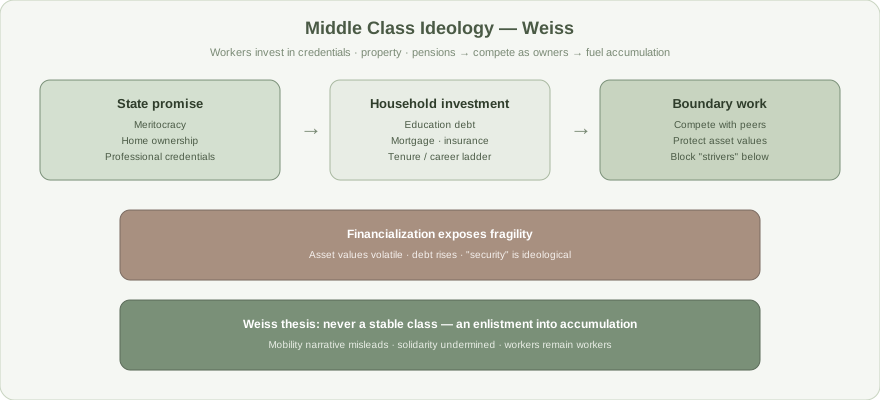
We have never been middle class — not because no one ever had a suburban house and a salaried job, but because that experience was always conditional, indebted, and politically useful to elites as a buffer against class conflict.
Weiss is not denying that people experience stability or consumption patterns associated with “middle class life.” She denies that those experiences form a class-for-itself that mobility policy can reliably expand. The ideology says: invest correctly and you earn security. The structure says: security is asset-dependent, and assets concentrate upward.
Key concepts (reference tables)
Financialization
| Aspect | Definition in Weiss | Everyday symptom |
|---|---|---|
| Logic | Profit and security sought through financial markets and instruments, not only production | Pensions as portfolios; housing as wealth engine |
| Subject effect | Individuals absorb market risk once borne by firms or state | “My 401(k) failed me” vs wage stagnation |
| Political effect | Middle-class identity aligns with asset prices, not labor solidarity | Homeowner opposition to density; stock-market “economy” |
| Diagnostic question | Who holds the underlying assets you are told to mimic? |
Credentialization
| Aspect | Definition in Weiss | Everyday symptom |
|---|---|---|
| Logic | Education reframed as capital investment with expected return | “Degree pays for itself” |
| Labor effect | Credentials become entry tickets in arms races | Master’s required where BA once sufficed |
| Debt effect | Future earnings collateralize present borrowing | Student loans as rational bet—until they aren’t |
| Diagnostic question | If everyone gets the credential, who still wins? |
Property fetish
| Aspect | Definition in Weiss | Everyday symptom |
|---|---|---|
| Logic | Homeownership = moral adulthood + retirement plan | “Renting is throwing money away” |
| Political effect | Middle class defends appreciation rights over access | NIMBY, zoning as wealth defense |
| Fragility | Paper wealth vanishes in crashes; maintenance costs ignored | 2008, regional busts |
| Diagnostic question | Whose balance sheet gains when prices rise? |
Boundary work
| Aspect | Definition in Weiss | Everyday symptom |
|---|---|---|
| Logic | Status built by distinguishing self from “lower” groups | Taste, speech, school district, “work ethic” talk |
| **Political effect | Horizontal competition replaces vertical solidarity | Blame the “undeserving” poor or immigrants |
| Psychic cost | Constant performance of deservedness | Anxiety about slipping |
| Diagnostic question | Who profits when I refuse solidarity across the boundary I police? |
Double bind
| Aspect | Definition in Weiss | Everyday symptom |
|---|---|---|
| Logic | You must invest in self; outcomes are uncertain and blamed on you | “You didn’t hustle enough” |
| Institutional | State and firms offload risk while demanding self-optimization | Gig “entrepreneurs,” portfolio careers |
| Temporal | Short-term flexibility, long-term insecurity | Contract work + future pension anxiety |
| Diagnostic question | Which side of the bind is structurally guaranteed to win? |
Worker-as-investor
| Aspect | Definition in Weiss | Everyday symptom |
|---|---|---|
| Logic | Labor power reframed as human capital you own and must grow | Personal branding, upskilling mantras |
| Management fit | Aligns with HR narratives of self-driven development | “Your career is yours to manage” |
| Solidarity break | Competing portfolios, not shared bargaining | Peers as rivals for scarce slots |
| Diagnostic question | If I am an investor, why can’t I fire my boss? |
I. Social mobility as misleading promise
Context
Postwar Western prosperity made rising expectations feel normal. Parties of left and right converged on “expand the middle”—through education, homeownership, small business. After deindustrialization and financial crisis, the rhetoric persisted while wages, unions, and public goods eroded. Mobility became a moral duty: if you stall, you failed the formula.
Depth
Weiss traces mobility talk to a pacification function: promise future inclusion to those currently excluded, and promise the already-included that their status is earned, not lucky or subsidized. That promise:
- Naturalizes inequality — winners had better human-capital portfolios
- Deflects redistribution — fix the pipeline, not the cap table
- Fractures coalitions — each household optimizes alone
This is where Courage to Be Disliked meets sociology: Adlerian “task separation” can free individuals from approval traps, but Weiss asks the structural question—who designed the task list?
Cases (as Weiss discusses)
| Setting | Mobility story | Structural counterpoint |
|---|---|---|
| US | College + home = American Dream | Debt, regional housing capture, wage bifurcation |
| Germany | Vocational prestige + stable Mittelstand | Hartz reforms, rental stress, credential creep |
| Israel | Startup nation + professional ascent | Security economy, housing protests, inequality |
Usage scenarios
- Career coaching — Before selling another certificate, map who captures returns on aggregated credentials.
- Policy debate — Ask whether a program increases mobility anecdotes or shared bargaining power.
- Family talk — Separate love for a child’s future from investment theology that blames them for macro shocks.
- Union / civic organizing — Replace “ climb individually” with common risk language (rent, care, hours).
Anti-patterns
| Anti-pattern | Why it fails |
|---|---|
| Meritocracy audit only at the individual | Ignores slot scarcity and asset rules |
| “Just learn to code” | Credential arms race without wage floor |
| Hero narratives | One outlier proves the system works |
| Poverty moralism | Boundary work disguised as ethics |
| Nostalgic 1960s middle | That stability was policy + geopolitics, not virtue alone |
II. Financialization and individualized risk
Context
Firms once offered longer job tenures and defined-benefit pensions; states expanded social insurance. From the 1970s onward, capital mobility, shareholder value, and privatized retirement shifted risk onto households. Middle-class ideology reframed that shift as freedom—you choose your portfolio.
Depth
Financialization does not mean everyone trades stocks. It means decisions about housing, education, health, and old age are mediated as investment calculations. The middle-class subject must read markets, tax codes, and school rankings like a fund manager—while lacking inside information or leverage.
Link to Management Essence: organizations design exchange structures; financialized workers experience exchange as self-negotiated bets without a clear counterparty to hold accountable.
Gazzaniga helps here: people narrate downturns as personal mistakes after the fact. Weiss wants pre-hoc structural sight—who guaranteed the upside to asset holders?
Cases
- US — 401(k) replaces pension; healthcare tied to employment; housing as primary wealth.
- Germany — Stronger rental tradition yet financial products and pension reforms import investor subjectivity.
- Israel — High home prices, security-linked economy; middle-class protests over cost of living clash with startup glamour.
Usage scenarios
- Benefits design — Label clearly what risk the firm still bears vs what it exported.
- Personal finance media critique — Ask whose commissions rise when you “optimize.”
- Retrospectives — Use Effective Retrospective on projects, not life outcomes; macro variance is not a sprint failure.
Anti-patterns
| Anti-pattern | Correction |
|---|---|
| “We’re all entrepreneurs now” | Entrepreneurs have equity; gig workers have tasks |
| Stock price = national mood | Asset holders ≠ wage earners |
| DIY retirement as empowerment | Without wage growth, savings rate is a cruel joke |
| Blaming financial illiteracy | Illiteracy is not the main extractor |
III. Credentialization and the education arms race
Context
Weiss treats degrees as positional goods masquerading as pure skill. States and families fund education as human-capital appreciation; institutions expand credentials as revenue; employers use credentials as cheap filters.
Depth
Credentialization turns schools into gatekeepers and students into debtors betting on themselves. The double bind: you must borrow to compete; if wages don’t rise, you failed the investment thesis—not the employers who captured productivity gains.
Parallel to The Algorithm: deleting bureaucratic steps is vital in firms, but credential inflation adds steps society-wide—another master’s, another bootcamp certificate—without deleting the underlying scarcity.
Cases
- Interviewees justify debt as rational while fearing irrelevance.
- Professional fields tighten entry to protect incumbent rents.
- Cross-national comparison: German vocational pride vs creeping academicization.
Usage scenarios
- Hiring — Skills tests vs degree filters: who gains from the filter?
- Parental planning — Distinguish learning from ticket-buying.
- Public funding — Free college debates should include positional dynamics, not only tuition numbers.
Anti-patterns
| Anti-pattern | Why |
|---|---|
| Infinite upskilling | Arms race without collective wage lift |
| Prestige chasing | Boundary work, not capability |
| “Education fixes inequality” | Can reproduce it when assets matter more |
| Shaming dropouts | Scarcity of dignified non-degree paths is policy choice |
IV. Property fetish and housing as class project
Context
Homeownership became the icon of middle-class belonging—stability, discipline, community membership. Weiss reads this as property fetish: housing’s use value (shelter) subordinated to exchange value (appreciation).
Depth
When your retirement plan is your zip code, you become a stakeholder in scarcity. Politics tilts toward restricting supply that might hurt prices, not toward abundant housing or tenant power. Crashes reveal the fetish: paper millionaires become debt prisoners; ideology says they speculated wrong, not that housing was never a safe universal asset.
Parallel lens (China, not in Weiss): urban homeownership as family milestone, marriage market signal, and store of value under financial repression—same fetish structure, different policy tools. Use as comparison, not as Weiss’s empirical claim.
Cases
- US suburban identity and 2008 aftermath.
- Israeli 2011 cost-of-living protests centered on rent and homes.
- German tenant protections vs rising financial landlord logic.
Usage scenarios
- Local politics — Separate “need affordable shelter” from “need my asset to beat inflation.”
- Career moves — Geographic mobility collides with illiquid bet on one house.
- Intergenerational help — Down-payment gifts reproduce advantage, contradicting pure meritocracy.
Anti-patterns
| Anti-pattern | Issue |
|---|---|
| Renters as failures | Moralism masking asset politics |
| NIMBY as environmental only | Often wealth defense |
| “Buy anytime” | Timing and regional policy dominate |
| Ignoring maintenance / tax / interest | True cost of ownership hidden |
V. Boundary work: distinguishing the deserving middle
Context
If the middle class is ideologically defined against working class or “underclass,” status requires visible distinction—accent, consumption, school, occupation, attitude toward work.
Depth
Boundary work horizontalizes conflict: the struggling professional resents the unionized worker’s pension; the tenant resents the “non-working” poor; the immigrant becomes scapegoat. Elites benefit when anxious middles police boundaries instead of questioning top-heavy asset rules.
Hanfeizi on 术 (methods) and visibility of reward: rulers profit when subjects compete for visible rank markers. Shangjunshu on weakening lateral solidarity to strengthen central control—an ancient rhyme with modern boundary politics, not a literal mapping.
Four Lenses: use the Guiguzi lens on interests—whose interest is served when I insist I am not “that kind of person”?
Cases
- Professional classes narrate taste and discipline as merit.
- Stigma attached to manual labor despite essential work.
- Ethnic and national boundaries overlap with class boundaries in Israeli and German field sites.
Usage scenarios
- Workplace culture — “Professionalism” codes often = boundary markers.
- Media diet — Outrage at “welfare queens” vs tax subsidies for homeowners.
- Solidarity building — Find shared risks (rent, care, hours) across occupational lines.
Anti-patterns
| Anti-pattern | Cost |
|---|---|
| Performative busyness | Distinction without security |
| Mocking “low skill” | Erases bargaining power |
| Credential snobbery | Reproduces pipeline politics |
| Aspiration shaming | Vertical cruelty, horizontal benefit to elites |
VI. The double bind and worker-as-investor
Context
Neoliberal labor markets demand flexibility, lifelong learning, and personal responsibility for outcomes firms once shared. Weiss names the double bind: you must invest continuously; failure is personal; success is never secure enough to stop investing.
Depth
The worker-as-investor merges employee and capitalist in one body—a fiction. You manage skills like stock, but you cannot diversify your life the way wealth holders diversify assets. You cannot sell shares of yourself without commodifying identity to exhaustion.
Tie to Sunzi: strategy assumes terrain and supply lines; the investor-worker fights on terrain they do not own, with supply lines (health, childcare, housing) priced by others.
Cases
- Portfolio careers praised while benefits fragment.
- Middle managers internalize self-optimization rhetoric from HR.
- Anxiety disorders and meritocracy shame in interview narratives.
Usage scenarios
- HR / L&D — Pair development offers with real risk sharing (time, pay floor, portability).
- Therapy vs sociology — Individual relief is valid; also name bind structure so shame loosens.
- Side hustles — Second jobs as necessity dressed as entrepreneurship.
Anti-patterns
| Anti-pattern | Reality |
|---|---|
| “You’re the CEO of you” | CEOs have boards and capital |
| Wellness as fix | Binds are material |
| Hustle porn | Surplus time harvested cheaply |
| Blaming burnout | Burnout follows bind design |
Ethnographic threads: Germany, Israel, United States
| Thread | What Weiss foregrounds | Ideological work observed |
|---|---|---|
| Germany | Vocational respect, Mittelstand mythology, post-Hartz insecurity | Stability narrative persists after welfare retrenchment |
| Israel | Professional/middle ascent vs housing protests, security state economy | Startup glamour coexists with cost-of-living rage |
| United States | Home + college dream, racialized history of who got FHA/suburb access | Mobility story excludes then blames excluded |
Reading tip: compare what interviewees say (“I made smart choices”) with what structures repeat (rent, debt, who inherited down payments). Zizhi Tongjian teaches long-cycle pattern reading—useful discipline when mobility anecdotes tempt short memory.
Modern applications (2020s)
| Domain | Middle-class ideology at work | Weissian question |
|---|---|---|
| Education debt | BA/MA as mandatory bet | If debt is “good,” why isn’t wage share rising? |
| Housing | Remote work + rate shocks expose illiquid plans | Who wins on reload/refinance cycles? |
| Gig economy | Flexibility framed as freedom | Where is the equity stake? |
| Meritocracy anxiety | Children as prestige projects | Boundary work through parenting |
| Tech layoffs | “Invest in skills” after cap-table wins | Why is labor the adjustable line item? |
| AI upskilling rush | New credential gold rush | Same positional game, faster clock |
Parallel lens: China (brief)
Weiss does not study China; readers there or in diaspora may still map:
- Apartment as family security — property fetish with local land-finance logic
- Gaokao / credential arms race — credentialization at societal scale
- “Middle class” consumer branding — ideology without stable Western welfare assumptions
Treat as structural rhyme, not evidence inside the book.
Cross-links on this site
| Note | Focus | Relation to Weiss |
|---|---|---|
| Management Essence | Exchange structures | HR “invest in yourself” without firm risk-sharing = one-sided exchange |
| The Algorithm | Delete bureaucratic bloat | Society-wide credential bloat needs political delete, not only personal hustle |
| Hanfeizi | Power, visibility, method | Rank games distract from asset concentration |
| Shangjunshu | Weak lateral ties | Boundary work weakens horizontal solidarity |
| Zizhi Tongjian | Long cycles | Mobility faith ignores generational asset resets |
| Four Lenses | Multi-lens decisions | See ideology, interest, composure, intuition together |
| Courage to Be Disliked | Meritocracy, approval | Individual freedom from others’ expectations ≠ structural mobility |
| Gazzaniga | Narrative self | Post-hoc stories of “smart choices” after outcomes known |
| Effective Retrospective | After-action learning | Audit narratives vs data in teams—and in macro life plans |
| Sunzi | Terrain, logistics | Fight on ground you don’t own = investor-worker bind |
One chain: Weiss names the ideology → Four Lenses split story from interest → Management Essence asks if exchange is mutual → Zizhi Tongjian widens the time horizon → collective politics (outside this book) picks up where individual narrative ends.
Analytical worksheets (not self-help)
Worksheet A — Mobility narrative audit
Use for a policy pitch, career plan, family decision, or media story—not as a scorecard of personal worth.
| Field | Your notes |
|-------|------------|
| **Story** | What is the mobility promise in one sentence? |
| **Hero** | Who is cast as the virtuous climber? |
| **Villain** | Who is implied to have chosen badly? |
| **Investment required** | Money, time, debt, relocation, credentials? |
| **Risk bearer** | If it fails, who eats the loss? |
| **Winner on success** | Employers, landlords, lenders, platforms, incumbents? |
| **Boundary work** | Who must I distinguish myself from to belong? |
| **Alternative** | What collective fix would change odds for everyone, not only me? |
| **Evidence** | One statistic or case that complicates the story |
| **Verdict** | Mostly structural / mostly individual / mixed (justify) |
Run quarterly on the same narrative (e.g., “buy now,” “MBA pays off,” “move to tech”). Compare rows over time—ideology shifts slowly; your audit should catch when the story outruns the data.
Worksheet B — Whose asset appreciates when I compete?
| My competitive move | Who else is forced to respond? | Asset or rent that likely rises | Who holds it upstream? |
|--------------------|--------------------------------|-----------------------------------|------------------------|
| Example: second degree | peers, juniors | tuition, credential filter value | universities, lenders |
| | | | |
| | | | |
| | | | |

Follow-up:
1. If everyone in my cohort does the same move, what happens to **my** edge?
2. What move would raise **bargaining power** instead of personal distinction?
3. What would [Management Essence](/blog_book_notes/2026/06/02/management-essence-interest-exchange/) call a fairer exchange here?
These worksheets are diagnostic, not therapeutic. They complement—but do not replace—therapy, union organizing, financial planning, or policy action.
VII. Political quiet and the missing class-for-itself
Context
Weiss ends in a sober place: middle-class ideology dampens class politics by promising individual exit routes. People who feel precarious still defend arrangements that hurt renters, debtors, and manual workers because they hope to cross to the safe side of the property and credential line.
Depth
A class-for-itself (in the old language) would recognize shared interests and bargain collectively. The investor-subject is a class-in-itself fragmented into portfolios: my home, my degree, my LinkedIn, my child’s school district. Each item suggests solo optimization rather than strike, rent strike, or tax politics.
This is where Hanfeizi meets modern sociology: when subjects compete for visible rank, central accumulation proceeds offstage. Shangjunshu on weakening lateral alliances rhymes with anti-solidarity—not as proof Weiss read Legalists, but as a cross-cultural warning about divide-and-rule.
Usage scenarios
- Election seasons — Flag when candidates offer mobility gadgets (vouchers, tiny tax cuts) without touching asset concentration.
- Professional associations — Ask whether the guild protects incumbent credentials or worker power broadly.
- Neighborhood meetings — Separate genuine planning concerns from price protection dressed as community character.
Anti-patterns
| Anti-pattern | Political effect |
|---|---|
| “I’m not political” | Politics already chose your risk load |
| Prestige charity | Moral glow without power shift |
| Populism against elites only | Can preserve middle boundary work against poorer groups |
| Technocratic denial of class | Mobility metrics as substitute for redistribution |
Eight arguments at a glance
| # | Argument | One-line takeaway |
|---|---|---|
| 1 | Mobility promise | Individualizes systemic risk |
| 2 | Financialization | Households absorb market volatility |
| 3 | Credentialization | Education becomes positional arms race |
| 4 | Property fetish | Shelter subordinated to appreciation politics |
| 5 | Boundary work | Status via distinction, not security |
| 6 | Double bind | Invest always; blame the self on failure |
| 7 | Worker-as-investor | Fictive merger of labor and capital in one body |
| 8 | Political quiet | Ideology fragments collective bargaining |
Weekly analytical practice (optional)
| Rhythm | Action |
|---|---|
| Weekly | One news story through Worksheet A (three rows minimum) |
| Monthly | One personal or family plan through Worksheet B |
| Quarterly | Re-read ethnographic comparison table; note what changed in your city |
| Yearly | Pair with Zizhi Tongjian long-cycle reading—one chapter on rise/fall of a dynasty as antidote to mobility amnesia |
【Friday prompt】What story this week told me to invest harder—and who sold it?
【Sunday prompt】Where did I do boundary work (taste, school, job title) without adding security?
【Month-end】One fairer exchange I could support collectively vs alone ([Management Essence](/blog_book_notes/2026/06/02/management-essence-interest-exchange/))
Not a wellness routine—a reality check rhythm so ideology does not become the only script.
Book usage map
| Module | One line | Use when |
|---|---|---|
| Ideology thesis | Middle class as story, not stratum | Debunking meritocracy sermons |
| Financialization | Risk shifted to households | Benefits, pensions, housing talk |
| Credentialization | Degrees as positional arms race | Hiring, education policy |
| Property fetish | Home as moral + financial idol | Zoning, rent, family pressure |
| Boundary work | Distinction from “lower” others | Culture wars, workplace codes |
| Double bind | Must invest; blamed if fail | Burnout, gig rhetoric |
| Ethnography | DE / IL / US compare | Avoid US-only mental model |
Reading boundaries
- Not a class membership quiz — Weiss refuses neat brackets; don’t read hunting for your label.
- Not deterministic — Ideology shapes action; people also resist and organize.
- Not anti-education — Critiques fetish and arms race, not learning itself.
- Not a housing sermon — Renting can be rational; critique is asset politics, not shaming renters or owners.
- Not China scholarship — Parallel lens only in this note.
- Not self-help — No ten steps to “true” middle class; worksheets are analytical.
- Pair with action — Diagnosis without solidarity or policy can curdle into cynicism.
- Don’t weaponize against the poor — Boundary work is the trap; don’t reproduce it while citing Weiss.
Common misreadings
| Misread | Correction |
|---|---|
| “Weiss says middle class doesn’t exist” | Experience exists; coherent progressive class does not |
| “Just don’t invest in yourself” | Question who profits, not all skill growth |
| “All homeowners are villains” | Structural analysis of political effects, not personal moral verdict |
| “Anthropology = anecdotes only” | Fieldwork illustrates repeatable ideological mechanisms |
| “Marxist = ignore culture” | Weiss takes identity and discourse seriously |
| “If mobility is fake, why try?” | Try with eyes open; choose solidaristic vs purely positional moves |
FAQ
Q1: Am I middle class or not?
Wrong question for this book. Ask: what risks am I carrying, and whose assets my labor and debt service support?
Q2: Is Weiss against homeownership?
She analyzes property fetish—when shelter must also be retirement lottery and moral badge. Policy and family choices differ; clarity beats fetish.
Q3: How does this relate to meritocracy?
Meritocracy is the moral soundtrack of mobility ideology. See Courage to Be Disliked for individual approval traps; Weiss for systemic merit narratives.
Q4: Germany isn’t the US—does the book still apply?
Yes—comparison is the point. Ideology adapts to local institutions (vocational pride, rental laws) without dissolving the investor-subject.
Q5: What about professionals earning well?
High income ≠ structural security if expenses, debt, and status competition consume the margin; many professionals do intense boundary work.
Q6: HR says “owners mindset”—Weiss?
Classic worker-as-investor language without equity. Contrast with Management Essence mutual exchange.
Q7: Student debt—is college still worth it?
Weiss would say “worth it for whom, at what marginal credential level?” Run Worksheet B; averages hide positional dynamics.
Q8: Gig work as freedom?
Freedom for capital scheduling; bind for workers. Entrepreneurship rhetoric without capital is ideology.
Q9: How do I talk to parents obsessed with stability?
Share risk map (housing, health, pension) without mocking their sacrifices; ideology often loves them while extracting from them.
Q10: What politics follows?
Book tilts left: redistribution, decommodification, tenant power, de-emphasizing asset appreciation as social goal. Weiss does not prescribe one party platform.
Q11: Relation to Gazzaniga?
Brains invent coherent stories after choices; mobility ideology supplies ready-made success and failure scripts.
Q12: Use with Effective Retrospective?
Yes for team learning loops; don’t treat macro setbacks as sprint failures without structural review.
Q13: Is this book pessimistic?
It refuses false comfort. Precarity is political, not a personal aura you can meditate away—though individual coping remains valid alongside structural sight.
Q14: Chibber vs Weiss?
Chibber often presses material class interests and professional-class blind spots; Weiss shows how subjects narrate and police middle identity in daily life. Read both: structure + lived ideology.
Q15: Managers reading this—practical takeaway?
Stop exporting risk while preaching ownership. If you want investor-mindset workers, share upside and stability—see Management Essence on mutual exchange.
Further reading
Primary and adjacent
- Hadas Weiss, We Have Never Been Middle Class (Verso 2019) — Verso Books
- David Harvey, A Brief History of Neoliberalism — financialization context
- Wendy Brown, Undoing the Demos — neoliberal rationality and citizenship
- Pierre Bourdieu, Distinction — taste and class boundary work (classic antecedent)
- Thomas Piketty, Capital in the Twenty-First Century — r > g and wealth divergence
- Daniel Markovits, The Meritocracy Trap — complementary US-focused argument
- Vivek Chibber, critiques of professional-class politics — read alongside Weiss when debating who speaks for “middle” interests (Chibber’s Postcolonial Theory and the Specter of Capital is elsewhere; his essays on class and academia pair as friendly friction to Weiss’s anthropology)
On this site
Management Essence · The Algorithm · Hanfeizi · Shangjunshu · Zizhi Tongjian · Four Lenses · Courage to Be Disliked · Gazzaniga · Effective Retrospective · Sunzi
Status
Reading — mobility narrative audits on housing and credential debates; cross-notes with meritocracy and exchange-structure posts