The Algorithm — Jon McNeill
The Algorithm: The Hypergrowth Formula that Transformed Tesla, Lululemon, General Motors and SpaceX
By Jon McNeill · ~224 pages · Apple Books
Overview
Before joining Tesla, Jon McNeill had founded and sold six startups. Sheryl Sandberg introduced him to Elon Musk. He came in steeped in Toyota lean thinking—incremental improvement, efficiency gains, polishing existing processes. Tesla ran a different logic: question every premise, attack complexity, set goals that look impossible until they are not.
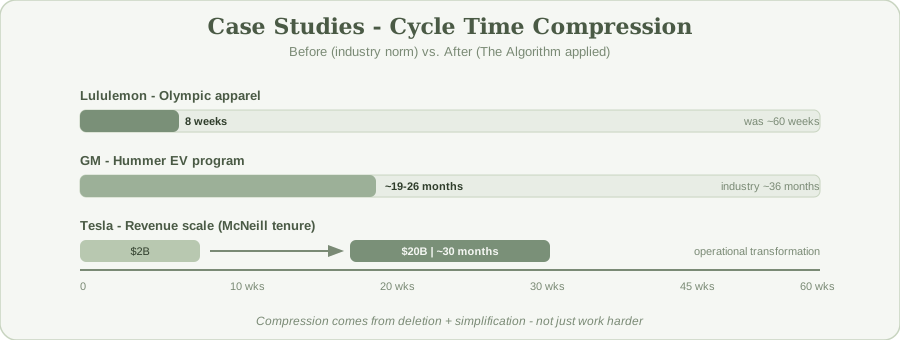
McNeill calls the five-step framework The Algorithm. As Tesla president (2015–2018), revenue grew from about $2B to $20B in roughly 30 months. After leaving, the same method was applied at Lyft, Lululemon, General Motors, and companies across industries.
The core is a weekly cadence—not a one-off workshop, but a loop teams run every week. Subtraction becomes an operating system, not a line in a quarterly OKR deck.
Three questions to carry while reading: Who set this requirement and why is it still here? If we started from zero, which steps should not exist? Is automation proving a process—or avoiding thinking?
Context checklist (read before you start)
| # | Element | Notes |
|---|---|---|
| 1 | Author | Serial entrepreneur + operator-president; “provocative but kind,” not a Musk biography |
| 2 | Era | EV disruption, production hell, legacy OEM turnaround, Olympic-scale supply compression |
| 3 | Fork from lean | Lean optimizes an existing map; the Algorithm prunes first—different data structure |
| 4 | Power dependency | L1 executive delete authority is architectural; middle management without it becomes theater |
| 5 | Reading stance | OS manual, not leadership fluff; does not teach copying Musk’s personality |
| 6 | Modern mapping | Approval chains, meeting bloat, feature creep, stage gates, page counts, org layering |
| 7 | Boundaries series | Deleting process ≠ deleting interpersonal boundaries; see Art of Saying No and Management Essence |
| 8 | Retrospectives | Weekly rhythm needs Effective Retrospective or complexity grows back |
| 9 | Classics | Sunzi on speed and position; Hanfeizi on institutional power; Caigentan on cutting performative busyness |
| 10 | Emotion skills | High-pressure deletion triggers defense; stabilize with DBT before hard delete conversations |
Who this book is for
| Good fit | CEOs, founders, board members, operators with authority to delete process; partial use at department/product level |
| When to use | Capacity crisis, hypergrowth, legacy complexity, existential competitive threat |
| What you get | A repeatable speed OS—deletion-driven innovation and cycle compression, not a cult-of-personality manual |
| What it is not | Lean/Kaizen guide, leadership style biography, personal productivity hacks |
Read if you:
- Run (or advise) a company drowning in approvals, meetings, and “requirements with no owner”
- Need shorter timelines—R&D, launch, manufacturing, creative delivery
- Want Tesla, SpaceX, GM, Lululemon cases plus a portable framework
Wait if you:
- Only want 1% incremental improvement on stable processes (lean/TPS fits better)
- Lack executive “delete backing”—middle layers get reversed by organizational immune response
- Expect gentle culture change—McNeill describes special forces, not a regular army
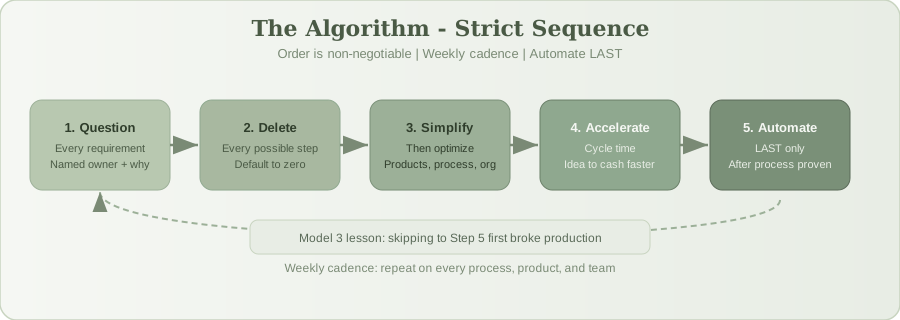
Five steps at a glance
- Question every requirement
- Delete every possible step
- Simplify and optimize
- Accelerate cycle time
- Automate last
System architecture
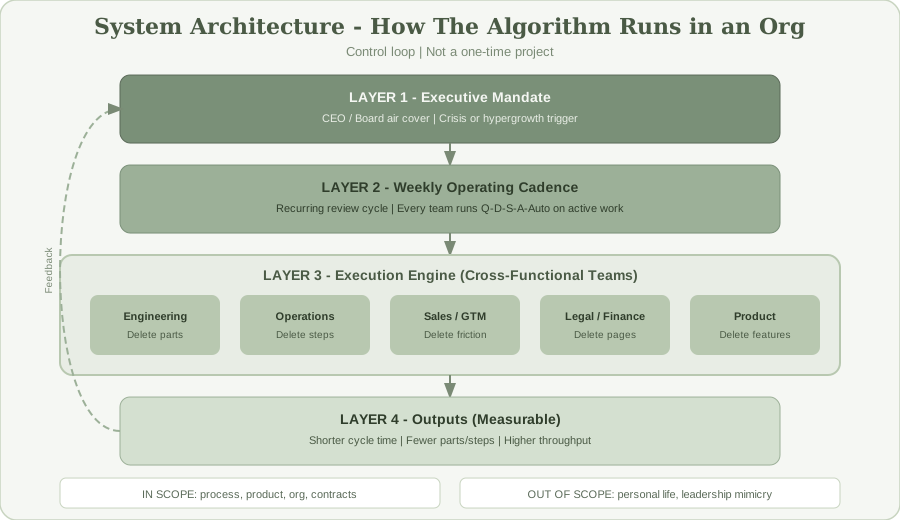
Treat the Algorithm as an organizational operating system—a closed control loop, not a checklist.
Four layers
| Layer | Component | Key elements |
|---|---|---|
| L1 | Executive mandate | Crisis/hypergrowth trigger; board + CEO back “deletion” |
| L2 | Weekly cadence | Loop Q→D→S→A→Auto; operating rhythm, not quarterly offsite |
| L3 | Cross-functional teams | Eng · ops · GTM; each function deletes its own complexity |
| L4 | Output metrics | Cycle time · part count · dollars; feedback to L1/L2 |
Control flow
| Phase | Input | Transform | Output |
|---|---|---|---|
| Question | Legacy requirements, specs, tradition | Name owner, ask “why” | Requirements proved or retired |
| Delete | Surviving requirements | Remove steps, parts, gates, pages | Minimum viable process |
| Simplify | Remaining process | Fewer interfaces, merge | Clean, tunable system |
| Accelerate | Clean process | Parallelize, shorten feedback | Shorter idea-to-cash |
| Automate | Stable proven process | Machines, software, robots | Scaled throughput |
Feedback arrows separate one-time reorgs from a real OS: rerun the loop weekly to fight complexity that grows back.
Lean vs. the Algorithm
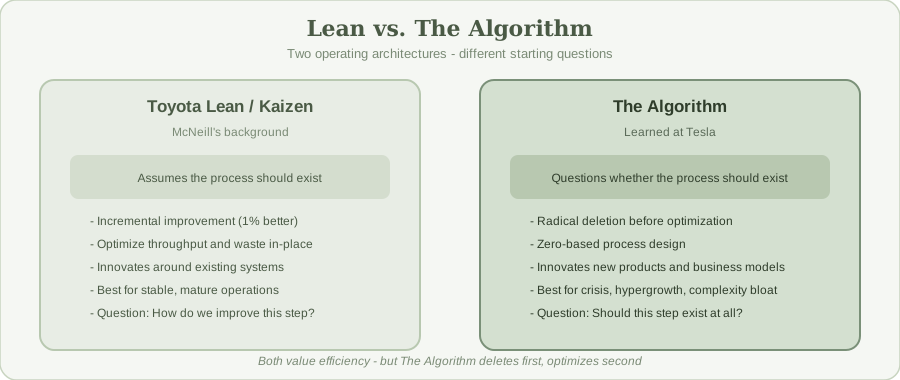
| Dimension | Lean / TPS | The Algorithm |
|---|---|---|
| Default | Process exists and should improve | Process must earn its existence |
| Primary move | Optimize (Kaizen) | Delete first, then optimize |
| Innovation type | Process innovation | Product and business-model innovation |
| Best environment | Stable manufacturing | Crisis, hypergrowth, legacy bloat |
| Failure mode | Efficient waste | Automating too early (Model 3) |
McNeill’s architectural point: you cannot pipe lean straight into a hypergrowth problem—lean mutates an existing map; the Algorithm prunes the tree.
System boundaries
In scope: Manufacturing, product design, sales flows, legal docs, org structure, approval chains, feature sets, supply gates.
Out of scope: Personal life (McNeill’s kitchen optimization experiment was vetoed at home), copying Musk’s leadership persona, mental-health support (McNeill learned this in 2017 the hard way).
Critical dependency: L1 must hold. Without top-down delete authority, L3 teams get rolled back by middle layers protecting headcount and turf—architecture collapses into theater. Same shape as Hanfeizi on power: without shi (势), rules spin idle.
Deletion as the kernel
If the book compresses to one system primitive: deletion is the kernel; everything else is scheduling.
- Question = garbage collection for requirements (find dead rules)
- Simplify = compression of what remains (merge survivors)
- Accelerate = performance gain from fewer hops
- Automate = replication of what survived (scale throughput)
Gigacasting is the purest example: delete hundreds of parts → halve factory footprint → shorten cycle → then automate casting.
Deep dive: step by step
1. Question every requirement
Core question: Who required this? Why?
Requirements often outlive the people who wrote them. Specs for constraints that no longer exist become invisible drag. Every requirement needs a named owner and a defensible reason—not “we’ve always done it.”
This is where lean and the Algorithm diverge most: lean asks how do we improve this step? the Algorithm asks should this step exist?
Context
- Zombie requirements: No owner, nobody dares delete, everyone complies.
- Emotion disguised as process: Compliance anxiety, tradition, fear of blame—not real requirements.
- Cross-read Caigentan “lower the self”: before questioning others, ask—is this my fear or real necessity?
Practical filters
| Question | Pass criteria |
|---|---|
| Can the requester state it in one sentence? | No → suspend |
| Does the reason still hold for today’s tech/scale/market? | No → delete |
| If we removed it tomorrow, what actually breaks? | Can’t say → try deleting |
Usage by scenario
| Scenario | Questioning move | Concrete action |
|---|---|---|
| Stage gates | Who defined each gate? | List owner, year created, invalidation condition per gate |
| Feature requests | User or sales anecdote? | Named stakeholder + measurable outcome |
| Compliance docs | Regulator or internal pile-on? | Legal tags “statutory minimum” vs “habit padding” |
| Meetings | Who required full attendance? | Default optional; attendance needs a reason |
| Job descriptions | Degree/years filters | Ask: would we still hire competent people without them? |
Anti-patterns
| Misuse | Consequence | Fix |
|---|---|---|
| Questioning becomes personal attack | Defensiveness, politics | Challenge the rule, not the person; “provocative but kind” |
| Question without delete follow-through | Talk only | Question week must feed delete week |
| Middle management questions without mandate | Overruled | Secure L1 backing or narrow pilot scope |
Vignette: SOC2 bloat at a SaaS company
A B2B firm prepping SOC2 saw security expand 12 controls into 47 internal processes—19 had no audit mapping, only “previous CISO preference.” New COO ran step 1: owner + audit map per line; 11 retired on the spot; cycle dropped from 14 to 9 weeks. Questioning is not anti-compliance; it is anti ownerless rules.
Mantra: No owner, no rule; ask who, then why.
2. Delete every possible step
Deletion is the highest leverage move—and the one most orgs skip because it feels risky.
McNeill: you cannot optimize your way out of unnecessary complexity; dashboards, reviews, and approvals on a bloated flow just make bloat efficient.
Mindset shift: Default to zero. Every step must earn its place. If nobody can say what breaks when you remove it, you probably have not tried removing it.
Delete targets: Not only factory steps—meetings, approval layers, document pages, handoffs, unused features.
Context
- Organizational immune system: deleting process threatens headcount and power; needs L1 cover.
- Sunzi on speed: delete for velocity dividend, not deletion for its own sake.
- Boundaries: delete process steps, not interpersonal limits in Art of Saying No.
Usage by scenario
| Scenario | Delete move | Concrete action |
|---|---|---|
| Approval chain | Default one level | More than two levels needs written justification |
| Standing meetings | Calendar audit | No decision output → cancel or async |
| Product features | Usage <5% | Deprecate or hide; shrink maintenance surface |
| Documents | Page caps | Loan-contract style: cut pages before polish |
| Handoffs | Role merge | Same info should not pass through three+ people |
Anti-patterns
| Misuse | Consequence | Fix |
|---|---|---|
| Delete safety-critical steps | Incidents | Separate statutory vs optional in question phase |
| Delete without communication | Backlash | Say what was removed and why it is safe |
| Delete frontline rituals but not executive ones | Hypocrisy | L1 deletes their own meetings first |
Vignette: seven review layers on hardware
A consumer electronics team ran seven cross-functional reviews, ~3 days prep each. Only two changed substantive decisions. With president backing: merged to two “decision reviews” + async comments; launch moved up 11 weeks. Deleted duplicate gates, not quality.
Mantra: Default zero, earn every step; only what survives deserves optimization.
3. Simplify and optimize
Order is non-negotiable. Delete first, optimize second. McNeill extends simplification to product, org, communication, contracts, goals, strategy.
Teams that shout “speed up” before cutting waste weld waste in place. Simplification is design work—fewer parts, interfaces, decision points—then tune what remains.
Context
- A 40-page loan contract cannot be “optimized” into a good experience—you delete to essence (Tesla’s one-page loan is that logic).
- Four Lenses: simplify to reduce decision variables, then choose.
Usage by scenario
| Scenario | Simplify move | Concrete action |
|---|---|---|
| Product SKU | Combination explosion | 80/20 SKUs cover volume |
| Org design | Dense matrix | Single reporting line preferred |
| Communication | Too many channels | One channel per initiative |
| Contracts | Repeated clauses | Standard modules + exception appendix |
| Goals | OKR pile-up | One focal metric per team |
Anti-patterns
| Misuse | Consequence | Fix |
|---|---|---|
| Simplify = layoffs | Fear culture | Cut process and interfaces first; people decisions separate |
| Over-unification | Lost flexibility | Simplify core path; modular edges |
| “Re-architect” without delete | New skin on bloat | Delete list before refactor |
Vignette: five-ticket systems
Customer issues were logged in five systems. After simplification: one ticket source + three required fields, rest auto-synced. Resolution time −34%—not from hiring, from fewer interfaces.
Mantra: Delete then tune; fewer interfaces, cleaner knobs.
4. Accelerate cycle time
Cycle time = time from raw material (or idea) to cash in the bank. Shorter cycles mean customers get product faster, the company learns faster, capital turns faster.
McNeill ties this to compounding learning: each week shaved off development is an extra iteration per year—in hypergrowth, iteration advantage often beats planning advantage.
Context
- Accelerate only after the process deserves to exist (steps 1–3 done).
- Pair with Effective Retrospective: short cycles + weekly retro = learning flywheel.
- Caigentan on “years are long, the hurried shorten them”: separate busy work (delete with Algorithm) from anxious hurry (inner work / DBT).
Acceleration levers
| Lever | Mechanism |
|---|---|
| Fewer handoffs | Byproduct of deletion |
| Clear requirements | Byproduct of questioning |
| Parallel instead of serial gates | Unpick dependency graph |
| Physical proximity / tight comms loops | Less waiting |
Anti-pattern
Stepping on the gas for a process that should not exist—faster wrong direction.
Vignette: content team “weekly → daily”
Marketing tried to “accelerate output” with overtime; burnout rose. Algorithm reset: cut three approval tiers → three templates → parallel write/design → automate layout last. Output doubled; overtime fell. Accelerated a clean pipe, not hours.
Mantra: Shorter cycle, more learning rounds; clean the pipe before throttle.
5. Automate last
This step exists because Tesla learned the hard way.
Model 3 over-automated—robots doing what humans did faster and more flexibly; production stalled. Lesson baked in: automate only after the process is proved, simplified, and stable.
Automation is a multiplier: bad process → scaled bad output; clean process → competitive moat.
Context
- Unlike lean automation: the Algorithm stresses sequence; automation is step 5, not step 2.
- Hanfeizi: tools must serve validated method; technique without law breeds chaos.
Pre-automation checklist
| # | Check |
|---|---|
| 1 | Process structurally unchanged for 4+ weeks? |
| 2 | Delete and simplify lists closed? |
| 3 | Human path shortest and repeatable? |
| 4 | Failure modes documented? |
| 5 | Automation ROI based on stable throughput? |
Anti-patterns
| Misuse | Consequence | Fix |
|---|---|---|
| Robots for “high tech” optics | Model 3 stall | Humans prove path first |
| Automate unvalidated flow | Scaled errors | Shadow run small |
| Ignore maintenance cost | Higher TCO | Automate including ops in ROI |
Vignette: finance close RPA
Company RPA’d a 127-step close checklist without simplification; bots faithfully ran waste; error rate rose. Rollback: cut to 42 steps → manual stable 2 months → then automate data entry. Machines amplify the structure you feed them.
Mantra: Humans prove the path; machines scale it; wrong order makes automation worse.
Case studies
Tesla Model 3 — automation mistake
The framework was not born from theory but from failure. Over-automation delayed Model 3; the rule was written: automate too early and you can “wreck the whole framework.” Step 5 stays last.
The book’s loudest warning: the Algorithm is not pro-tech; it is pro correct order.
Tesla gigacasting — delete half a factory
Engineers questioned: why hundreds of stamped welded body parts? Breakthrough gigacasting—one large cast replaces many. Result: ~half the footprint for that production segment. Steps 1–2 executed on the floor, not Musk drawing castings.
Takeaway: You do not have to be Elon; the framework unlocks frontline breakthroughs.
Tesla mobile service & one-page loan
| Innovation | What was deleted | Impact |
|---|---|---|
| Mobile service | “Must visit service center” | Repairs at customer; capacity without new buildings |
| One-page loan | 40+ pages of decades of boilerplate | Faster purchase; same regulatory outcome |
Both started by questioning who needed the old rules.
GM Hummer EV — ~19–26 months
Industry vehicle programs often run ~36 months. GM compressed Hummer EV to ~19–26 months (sources vary slightly). Not “work harder”—delete unnecessary gates, question legacy stage gates, accelerate what remains. McNeill served on GM’s board (2022–2026); century-old OEMs can change.
Takeaway: Not startup-only; needs leadership that will actually change.
Lululemon Olympic kit — 8 weeks
Olympic team kits often take ~60 weeks; Lululemon delivered Canada’s Beijing line in 8 weeks. McNeill (board) describes the same five steps on design, approval, production—question every gate, delete redundant reviews, simplify supply chain, then accelerate.
Takeaway: Cycle compression is not manufacturing-only; creative and commercial flows qualify.
SpaceX — machine that builds the machine
Same logic in the book: question disposable rockets, delete unnecessary components, simplify design (fewer parts), accelerate launch cadence, automate production only after the process runs.
Through-line: Radical simplification before scale.
Modern mirror: software release train
A unicorn kept a quarterly “release train” with 23 checklist items. Pilot team: questioned 9 with no incident correlation → deleted → merged CI to one pipe → biweekly releases → automated regression last. Incident rate flat; shipped features +40%. Same shape as GM deleting stage gates, different industry.
Key takeaways
Framework
| # | Point |
|---|---|
| 1 | Order is non-negotiable — Q→D→S→A→Auto; reorder fails, especially automating early |
| 2 | Deletion beats optimization — Most “improvement” optimizes waste instead of removing it |
| 3 | Requirements need owners — Anonymous requirements = zombie requirements |
| 4 | Weekly cadence, not one-shot — Continuous OS, not strategy offsite |
Leadership & culture
| # | Point |
|---|---|
| 5 | Top-down required — Without executive delete authority, middle layers reverse you |
| 6 | You don’t have to be Elon — Framework is separable from any one personality |
| 7 | Special forces, not regular army — High tempo, high bar; not everyone fits |
| 8 | Algorithm ≠ leadership development — Speed tool; does not replace EQ and self-work |
Boundaries & limits
| # | Point |
|---|---|
| 9 | Crisis enables adoption — Mature firms resist radical simplification; existential threat helps |
| 10 | Don’t optimize the kitchen — McNeill’s home experiment failed; life has more variables than a factory |
| 11 | Lean innovates process; Algorithm innovates product — TPS makes systems better; Algorithm asks if the system should exist |
Outcomes
| # | Point |
|---|---|
| 12 | Focus is the first dividend — Teams stop doing wrong things before breakthroughs |
| 13 | Breakthroughs compound — Each deletion frees space for the next innovation |
| 14 | Revenue follows operations — Tesla $2B→$20B was prod/sales/service transformation, not marketing alone |
Scenario selector
| Your pain | Prioritize | First move |
|---|---|---|
| Approvals always queued | Delete + question | Named audit of approval chain |
| More features, slower ship | Delete | Deprecate by usage |
| Docs nobody reads | Question + delete | Page caps |
| Factory robots often down | Automation order | Roll back to human proof |
| Legacy giant won’t move | L1 mandate | Single product-line pilot |
| Team burnout | Delete before accelerate | Separate busy work vs performative busy (Caigentan) |
| Middle management blocks | L1 + Hanfeizi shi | Executives publicly delete their own meetings |
| Deleted items grow back | L2 weekly + retro | Weekly complexity regression scan |
Weekly cadence templates
The Algorithm is not a book report—it is an OS you rerun weekly. Pair with Effective Retrospective KPT / three-line journal.
Standard team loop
Mon · Question — List requirements/process/meetings; each: owner + one-line reason
Tue · Delete — Flag no-owner/no-reason items; pilot-delete 1–3
Wed · Simplify — Merge interfaces/SKUs/docs; before/after table
Thu · Accelerate — Map critical path; parallelize one serial dependency; measure cycle
Fri · Retro — Automate only steps stable 4+ weeks; KPT on what grew back
Executive weekly (L1)
Mandate — What deletion did I back publicly this week? Did middle layers restore anything?
Metrics — Cycle time / part count / cost — one primary metric in weekly report
Immune response — Who blocked deletes citing “risk”? Real risk or turf?
Modeling — Which of my meetings/approvals did I delete?
Individual contributor (no delete authority)
In scope — One step deleted, one interface simplified in flows I own
Upward — Data proposal: deleting X saves Y days; ask for pilot
Boundaries — Practice saying no separately from process deletion (boundaries series)
Emotion — Use DBT distress skills before hard meetings in heavy weeks
8-week rollout
| Week | Focus | Deliverable |
|---|---|---|
| 1 | L1 alignment + pilot pick | Pilot charter |
| 2 | Question audit | Requirement/process list + owners |
| 3 | First delete batch | ≥3 deletion records |
| 4 | Simplify | Interface/SKU/doc before-after |
| 5 | Accelerate experiment | Critical path comparison |
| 6 | Retro anti-rebound | KPT + “grew back” list |
| 7 | Expand or deepen | Second team or product line |
| 8 | Automation assessment | ROI table on stable steps only |
Practice templates
Requirement audit
| ID | Requirement/step | Owner | Created | One-line reason | Invalid when | Action |
|----|------------------|-------|---------|-----------------|--------------|--------|
| 1  |                  |       |         |                 |              | keep/delete/pilot |
One-page delete proposal
What we delete:
Who set the original rule:
Worst case if removed: (specific, not “might be bad”)
Pilot: time / scope / rollback switch
Success metrics: one each for cycle / cost / quality
Needs L1 backing: Y/N
Friday retro — three questions
1. What did we delete this week? What grew back?
2. Did cycle time move? If not, which step is stuck (question/delete/simplify/accelerate/automate order)?
3. One bottleneck for next week — what is it?
Cross-links on this site
| Note | Focus | Relation to Algorithm |
|---|---|---|
| Sunzi | Speed, position | Deleting complexity = making opponent “empty”; cycle compression = 兵贵速 |
| Hanfeizi | Law, method, power | L1 shi enables deletes; without it, process rebounds |
| Caigentan | Inner composure | Busy work → Algorithm; anxious hurry → inner cultivation |
| Management Essence | Sustainable exchange | Delete process, not fair exchange |
| Effective Retrospective | After-action correction | Weekly Algorithm needs weekly retro closure |
| Four Lenses | Multi-lens decisions | Fewer variables after simplification |
| DBT Skills | Emotional/interpersonal stability | Stabilize before delete fights; DEAR MAN to propose cuts |
Boundaries series (delete process, not interpersonal limits):
| Note | Layer | With Algorithm |
|---|---|---|
| Courage to Be Disliked | Overview | Task separation: don’t avoid deletes from fear of others’ turf |
| Counselling for Toads | States | Adult state before proposing deletes |
| Art of Saying No | Skill | Say no to unjustified process load |
| Nonviolent Communication | Expression | Observation–request language for cut proposals |
| Highly Sensitive Person | Temperament | Recovery boundaries during noisy change |
| Intimate Relationships | Intimacy | Don’t Algorithm-optimize your spouse (kitchen lesson) |
One chain: Sunzi on position → Algorithm deletes bloat → Hanfeizi on power → Retro tests action → Caigentan/DBT tend the person.
Reading boundaries
- Not a universal drug — Stable mature businesses may fit lean better; don’t fake crises to justify cuts
- Not a humanity replacement — McNeill 2017: speed and deletion need psychological support; see DBT
- Not culture replacement — “Special forces” culture exits some people; hire and compensate honestly
- Not default for personal life — Kitchen, marriage, parenting: don’t mechanically optimize
- Must pair with interpersonal boundaries — Fewer approvals ≠ 24/7 availability; see boundaries series
- Beware performative Algorithm — Weekly “delete bloat” theater while middle layers restore steps—worse than doing nothing
Common misreadings
| Misread | Correction |
|---|---|
| “Algorithm = Musk management” | Collaborative and kind is possible; framework ≠ personality |
| “Delete = layoffs” | Delete steps and interfaces first; people decisions separate and transparent |
| “Automation = advanced” | Step five; Model 3 is the counterexample |
| “Question = contrarianism” | Challenge the rule; require owner and reason |
| “Accelerate = overtime” | Accelerate clean paths; overtime often signals broken process |
| “Middle management can run full stack” | Without L1 delete authority → theater |
| “Opposed to lean” | Different environments; pick a primary; stable mfg may stay lean |
FAQ
Q1: No CEO support—can I still use this?
Run all five steps on the smallest process you control; to expand, pitch pilots with cycle/cost data. Without L1, avoid company-wide delete theater—you become a target.
Q2: Can we delete compliance process?
In question phase, separate statutory minimum from internal padding. Optimize presentation of the former; delete the latter with legal sign-off.
Q3: Conflict with Agile/Scrum?
Not necessarily. Scrum that becomes ritual bloat (extra reviews, ownerless backlog items) is what the Algorithm trims. Keep short iterations; delete ceremonies with no learning output.
Q4: Deletes trigger fear?
Transparency: what, pilot duration, rollback switch; L1 owns accountability. Emotionally: DBT distress tolerance; structurally: DEAR MAN.
Q5: How to stop deleted steps growing back?
L2 weekly rhythm + Effective Retrospective tracking immune response—who restored what, in what name. New process needs new owner + new reason.
Q6: Won’t this kill creativity?
Algorithm deletes learning-blocking ritual, not exploration. Keep prototypes, experiments, user research; delete 40-page internal decks nobody reads.
Q7: Use with Four Lenses?
Before major cuts: Guiguzi on political shi, Yangming on avoiding hard calls, Caigentan on performative busyness, tarot/intuition as marginal signal—then decide on data.
Q8: Personal use?
Workflows yes (email templates, note systems, side-project delivery). Home life: McNeill kitchen lesson. Relationships: boundaries series, not Algorithm on people.
Q9: Time to results?
Book cases often show month-scale compression; culture shift may need 2–3 full 8-week cycles. Week-one dividend is often focus—fewer wrong things done.
Q10: Relation to The Goal / Goldratt?
The Goal finds the bottleneck; Algorithm often deletes steps beside the bottleneck before drumming it. Read both: Algorithm decides what to remove; The Goal decides where to constrain.
Step mantras
| Step | Mantra | One-line use |
|---|---|---|
| 1 Question | No owner, no rule | When stimulated, ask who set it |
| 2 Delete | Default zero | Only survivors get optimization |
| 3 Simplify | Delete before tune | Merge before polish |
| 4 Accelerate | Throttle clean pipe | Shorter cycle, more learning |
| 5 Automate | Humans prove, machines scale | Wrong order makes automation worse |
Further reading
- The Goal (Goldratt) — bottlenecks and systems thinking; Working Backwards (Amazon) — mechanisms culture
- Business Insider — McNeill on limits · Penguin title · FOMO Sapiens podcast
- On this site: Sunzi · Hanfeizi · Caigentan · Management Essence · We Have Never Been Middle Class — Weiss · Effective Retrospective · Four Lenses · DBT · Boundaries series
Status
Reading — chapter margin notes, pilot metrics, and personal weekly log in progress