Outlive — Peter Attia
Outlive: The Science and Art of Longevity
By Peter Attia, MD (2023) · Physician-engineer’s operating manual for healthspan · Core idea: Medicine 3.0 prevents chronic disease decades before symptoms—especially through exercise, nutrition, sleep, and emotional health treated as serious interventions
Overview
Peter Attia built a public following by asking uncomfortable questions: Why do we wait until the heart attack to care about lipids? Why is “exercise” a vague recommendation while oncology doses drugs to the milligram? Outlive is his attempt to name the enemy and the toolkit.
Medicine 1.0 — treat infection and trauma.
Medicine 2.0 — chronic disease management after diagnosis.
Medicine 3.0 — risk math + prevention for the diseases that actually kill most adults.
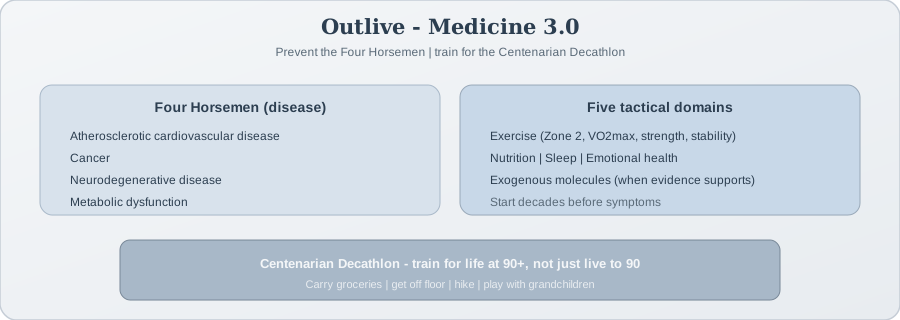
The book centers on the Four Horsemen (atherosclerosis, cancer, neurodegeneration, metabolic dysfunction) and five tactical domains: exercise, nutrition, sleep, emotional health, exogenous molecules (drugs/supplements when evidence warrants).
Attia’s motivational frame is the Centenarian Decathlon: train today for the physical tasks you want at 90—not merely survive to 90 depleted.
Three questions while reading: Which Horseman is my highest quantified risk? Is my exercise program covering all four buckets? Am I borrowing from tomorrow’s health for today’s comfort?
Context checklist
| # | Element | Notes |
|---|---|---|
| 1 | Author | Stanford/Johns Hopkins trained; former surgical resident; longevity practice |
| 2 | Genre | Popular science + memoir + protocols; not a substitute for your physician |
| 3 | Length | Dense; exercise and lipids sections reward slow reading |
| 4 | Quantification | Labs, VO2max, DEXA, CGM—data-heavy |
| 5 | Exercise emphasis | Calls exercise the most potent longevity drug |
| 6 | Nutrition | Individualized; critiques one-size dogma |
| 7 | Emotional health | Explicit pillar—stress, relationships, purpose |
| 8 | Controversy | Some supplement/pharma takes age quickly; verify with current evidence |
| 9 | Site links | Built to Move for stability habits; Starting Strength for strength base |
| 10 | Mind | DBT, Gazzaniga for emotional/neural layers |
Who this book is for
| Good fit | Midlife adults optimizing healthspan; data-curious readers; lifters adding cardio/metabolic layers |
| When to use | When “eat less move more” failed and you want a systems map |
| What you get | Framework, risk stories, exercise taxonomy, nutrition principles |
| What it is not | Personalized medical plan, cancer treatment guide, or quick biohack list |
Read with a doctor for lipids, hormones, and pharmacology decisions.
The Four Horsemen
| Horseman | Prevention theme |
|---|---|
| Cardiovascular disease | Lipids, blood pressure, apoB, exercise, sleep |
| Cancer | Screening, metabolic health, smoking, luck—honest limits of control |
| Neurodegenerative disease | Exercise, sleep, metabolic health, head injury avoidance |
| Metabolic dysfunction | Insulin resistance, visceral fat, muscle as organ |
Medicine 2.0 shines after diagnosis; Medicine 3.0 asks what to do in your 40s when everything still “looks fine.”
Exercise: the four-part prescription
Attia’s exercise chapter is the book’s operational core:
| Bucket | Target | Why |
|---|---|---|
| Stability | Balance, eccentric control, fall avoidance | “Margin of safety” in Centenarian Decathlon |
| Strength | Muscle mass and bone density | Metabolic organ; independence |
| Zone 2 | Aerobic base, mitochondrial health | Fat oxidation, cardiac output |
| VO2 max | Peak aerobic power | Strong mortality association |
Week template (conceptual — individualize)
3–4× Zone 2 sessions (talk test: nasal breathing possible)
1× VO2 / high-intensity intervals (when cleared)
3× strength (compound lifts + carries)
Daily stability snacks (see Built to Move)
Starting Strength covers strength novice phase; Attia tells you why you still need Zone 2 after LP ends. NROL offers staged lifting variety; Built to Move supplies daily stability practice.
Centenarian Decathlon
Instead of abstract “fitness,” list tasks at 90:
- Hike 1.5 miles on uneven ground
- Get up from floor with one point of contact
- Carry two bags of groceries five blocks
- Climb four flights of stairs
- Play on floor with a child
Train backward from those events: which muscle, energy system, and skill each demands?
Nutrition (principles, not a fad diet)
Attia emphasizes:
- Protein adequacy especially with age (muscle preservation)
- Glycemic control individualized—CGM stories illustrate, not mandate
- Energy balance without reckless crash diets
- Sustainability over performative restriction
Pair quantitative curiosity with 有效复盘—monthly review of labs, sleep, and training logs.
Sleep and emotional health
Sleep is framed as cardiovascular and cognitive medicine, not laziness. Emotional health includes stress, shame, anger, relationships—Attia’s personal chapters model vulnerability without replacing therapy.
For skills: DBT, NVC, professional support when needed.
Exogenous molecules
Drugs and supplements (statins, metformin debates, etc.) are discussed with risk-benefit math. This section ages fastest—treat as conversation starters with clinicians, not prescriptions.
Common failure modes
| Failure | Fix |
|---|---|
| VO2max obsession, no strength | Run the full exercise portfolio |
| Biohack shopping before sleep | Fix sleep and steps first |
| Ignoring emotional pillar | Schedule therapy/coaching like training |
| Copying Attia’s personal stack | Your labs and genetics differ |
| All analysis, no lifting | Starting Strength or coached equivalent |
Cross-links on this site
| Book / note | Role in stack |
|---|---|
| Starting Strength | Strength foundation |
| NROL | Periodized lifting + body comp |
| Built to Move | Stability + daily movement |
| 黄帝内经 | Alternate tradition of prevention and rhythm |
| Middle Class — Weiss | How economic stress steals sleep and health |
Critiques worth keeping
- Length and repetition — core ideas could be a long essay.
- Privilege lens — VO2 lab tests and concierge medicine are not universal.
- Evolving science — verify pharmacology against current guidelines.
- Memoir sections — powerful but emotionally heavy; pace yourself.
Still: for many readers, Outlive is the first time exercise dose felt as serious as drug dose.
Monthly review prompts
- Labs & metrics — any Horseman risk trending wrong?
- Exercise — did I hit Zone 2, strength, stability, and intensity this month?
- Sleep average — honest hours and consistency?
- Emotional load — what am I avoiding?
- Decathlon — which event at 90 am I neglecting in training today?
Related reading
- Peter Attia — The Drive podcast (ongoing nuance)
- Kelly & Juliet Starrett — Built to Move
- Lou Schuler & Alwyn Cosgrove — The New Rules of Lifting
- Mark Rippetoe — Starting Strength
- Built to Move — site notes
Status
Reading — Centenarian Decathlon list and Zone 2 logs to be added