Built to Move — Kelly Starrett & Juliet Starrett
Built to Move: The Ten Essential Habits to Help You Move Freely and Live Fully
By Kelly Starrett & Juliet Starrett (2023) · From the Ready State / mobility culture · Core idea: longevity is a movement problem you can score, practice daily, and retest—without living in a gym
Overview
After decades of coaching athletes and desk workers, the Starretts noticed a pattern: people either ignored mobility until something hurt, or treated it as a 90-minute yoga penance they could not sustain. Built to Move compresses the message into ten vital signs—simple assessments—and daily minimums that stack onto real life: meetings, parenting, travel, aging.
The book is not a replacement for strength training. It is the operating system for joints, breathing, and walking that makes strength programs survivable for decades.
You are not fragile; you are under-practiced. Move a little, often, with tests that tell the truth.
Three questions while reading: Which vital sign is my bottleneck? What is the smallest daily habit I will actually do? Am I retesting or just consuming mobility content?
Context checklist
| # | Element | Notes |
|---|---|---|
| 1 | Authors | Kelly—physio/coach, Becoming a Supple Leopard; Juliet—CEO, habit design |
| 2 | Tone | Practical, upbeat, corporate-wellness compatible |
| 3 | Audience | Adults 30–80; athletes and sedentary office workers |
| 4 | Not rehab | Assessments inform habits; acute injury needs clinicians |
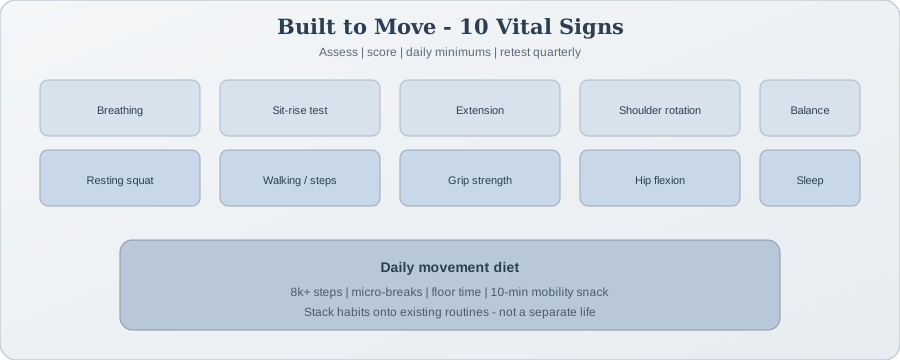
| 5 | Ten vital signs | Scoreable tests + corrective “snacks” |
| 6 | Movement diet | Steps, floor time, micro-breaks—not heroic sessions |
| 7 | Pairing | Best alongside Starting Strength or NROL |
| 8 | Sleep & breath | Treated as movement prerequisites |
| 9 | Site links | 黄帝内经 on rhythm and “free flow”; Outlive on stability as longevity pillar |
| 10 | Emotion | Chronic pain and fear of movement—stabilize with DBT before pushing through |
Who this book is for
| Good fit | Desk workers, parents, masters athletes, anyone “tight” who won’t stretch an hour |
| When to use | As a daily floor parallel to lifting; during travel or deload weeks |
| What you get | Tests, scores, habit stacks, family-friendly routines |
| What it is not | Powerlifting program, diagnosis, or substitute for loaded strength |
The ten vital signs (framework)
Exact protocols are in the book; conceptually:
| Vital sign | What it reveals |
|---|---|
| Breathing | Diaphragm and rib cage capacity—foundation for bracing |
| Sit-rise test | Floor-to-stand without hands—global mobility + strength |
| Extension | Hip/spine extension—counter sitting flexion |
| Shoulder rotation | Overhead and rotational readiness |
| Single-leg balance | Proprioception, ankle/hip stability |
| Resting squat | Ankle/hip depth for daily life |
| Walking / steps | Aerobic baseline and joint nutrition |
| Grip strength | All-cause mortality correlate; practical strength |
| Hip flexion | Sitting toll on hips and back |
| Sleep | Recovery without which mobility work fails |
Practice loop: baseline score → one or two daily snacks → retest quarterly.
Daily movement diet
Starretts argue for minimum effective movement embedded in the day:
8,000+ steps (more if life allows)
Micro-breaks every 30–45 min at desk
Floor time (sit on ground, shoes off when safe)
10-minute mobility “snack” (target weakest vital sign)
This is how mobility becomes infrastructure, not a weekend event.
Habit stacking examples
| Anchor | Stack |
|---|---|
| Morning coffee | 2 min breathing drill |
| Work timer | 5 squats + shoulder CARs |
| Evening TV | Floor sit instead of couch only |
| Post-lift | 5 min extension + hip flexor opener |
Sit-rise test (why it matters)
Popularized in longevity research, the sit-rise test is a blunt instrument: can you lower to the floor and stand without support? Low scores correlate with mortality risk in epidemiology—not because the test is magic, but because it bundles strength, balance, and mobility.
Built to Move uses it as a north star, not a shame club. Train toward it with Starting Strength-style strength plus daily snacks.
Common failure modes
| Failure | Fix |
|---|---|
| Mobility-only, no strength | Add barbell/dumbbell work |
| Heroic Sunday session | Shrink to daily minimum |
| Ignoring pain signals | Clinician for red flags; habits for capacity |
| No retest | Calendar quarterly vital-sign day |
| Gear obsession | Bands and floor beat expensive toys |
Cross-links on this site
| Lens | Connection |
|---|---|
| Starting Strength | Load creates need for recovery mobility |
| NROL | Periodized lifting + daily movement diet |
| Outlive | Stability pillar; grip; Zone 2 walking |
| 黄帝内经 | “Flow” and rhythm as older language for same problem |
| Effective Retrospective | Log vital signs like KPIs |
Critiques worth keeping
- Corporate wellness tone can feel simplified for serious athletes.
- Tests are proxies, not diagnoses.
- Kelly’s earlier catalog (Supple Leopard) is denser; Built to Move trades depth for adherence.
Use it to keep moving between birthdays, not to win Instagram contortion points.
Related reading
- Kelly Starrett — Becoming a Supple Leopard (deeper mobility encyclopedia)
- Peter Attia — Outlive
- Lou Schuler & Alwyn Cosgrove — The New Rules of Lifting
- Outlive — site notes
Status
Reading — vital sign baseline scores to be logged