Starting Strength — Mark Rippetoe
Starting Strength: Basic Barbell Training
By Mark Rippetoe (3rd ed., with contributions from Lon Kilgore and others) · The standard introduction to barbell training for novices · Core idea: a few compound lifts, trained with correct technique, progressed linearly while recovery still permits
Overview
Starting Strength is not a magazine workout or a collection of muscle-isolation routines. It is a minimal program built on biomechanics: squat, press, bench press, deadlift, and power clean—performed for sets across a full range of motion, with weight added session by session while the trainee is still a novice (someone who recovers from stress quickly enough to gain strength every workout).
Rippetoe’s argument is structural:
Strength is the productive adaptation of the body to stress. The program must deliver stress, allow recovery, and repeat—before the adaptation window closes.
The book is half instruction manual (how to squat, press, pull, and clean) and half theory of training (stress, recovery, adaptation; novice vs intermediate vs advanced). That makes it unusually durable: even readers who later switch programs often keep the lift models and the habit of adding weight only when form holds.
Three questions to carry while reading: Is the bar path correct? Am I recovering between sessions? When linear progression stops, what changes—not just what weight goes on the bar?
Context checklist (read before you start)
| # | Element | Notes |
|---|---|---|
| 1 | Author | Mark Rippetoe—coach, gym owner, vocal advocate of barbells; writing style direct, sometimes combative |
| 2 | Edition | 3rd edition (2011) is the usual reference; earlier editions differ in details |
| 3 | Audience | Healthy novice to early intermediate; assumes access to barbell, rack, bench, plates |
| 4 | Not bodybuilding | Optimizes strength, not hypertrophy aesthetics or sport-specific conditioning |
| 5 | Novice definition | Can add weight to the bar every workout (or nearly)—typically weeks to months, not years |
| 6 | Linear progression | Fixed sets/reps; load increases until recovery fails—then you are no longer a novice |
| 7 | Technique priority | Weight is earned by model-consistent form; grinding ugly reps is a program failure |
| 8 | Recovery stack | Sleep, food, stress management—not optional accessories to the program |
| 9 | Boundaries | Training stress is not an excuse to ignore injury signals; see DBT distress tolerance for riding discomfort vs ignoring harm |
| 10 | Site links | Effective Retrospective for logging sessions; 黄帝内经 on rhythm and recovery as a different tradition of “nourishing life” |
Who this book is for
| Good fit | Adults new to barbells; lifters tired of random programs; anyone who wants a clear default before specializing |
| When to use | After medical clearance for resistance training; when you can train 3×/week consistently |
| What you get | Detailed lift models, novice program, vocabulary for stress/recovery/adaptation |
| What it is not | Physique contest prep, Olympic weightlifting specialization, rehab protocol, or machine-circuit fitness |
Read if you:
- Want one book that teaches how to lift and how to program at the same time
- Prefer compound barbell movements over exercise variety for its own sake
- Need a shared language with coaches or training partners (“novice LP,” “reset,” “microload”)
Wait or supplement if you:
- Cannot squat or deadlift without pain—get assessed first; technique chapters help but are not medicine
- Need sport-specific speed, agility, or endurance—add those after a strength base or in parallel with managed volume
- Want minimalist home training without a rack—SS assumes a proper gym setup
The five lifts (why these, not others)
Rippetoe selects lifts that use the most muscle mass over the longest effective range of motion, loaded with a barbell:
| Lift | Role | Program note |
|---|---|---|
| Squat | Primary lower-body strength | High frequency (every session) drives adaptation |
| Press | Overhead strength | Strict standing press; no leg drive |
| Bench press | Horizontal push | Paired with press on alternate days |
| Deadlift | Posterior chain pull | One heavy set; high systemic stress |
| Power clean | Explosive pull + rack | Teaches acceleration; optional swap to barbell row in some variants |
Machines and cables are not evil—they are poor teachers of balance and rigid midline stabilization for a novice learning to move load with a barbell. SS is opinionated here on purpose.
Novice program structure
A/B template
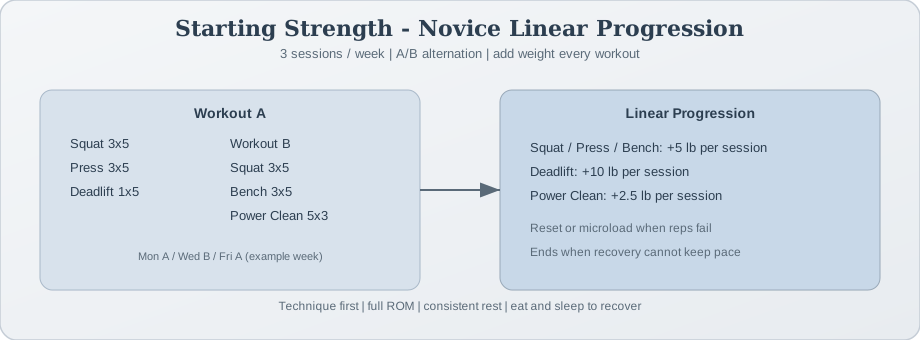
Typical week:
Monday    — Workout A: Squat, Press, Deadlift
Wednesday — Workout B: Squat, Bench, Power Clean
Friday    — Workout A (weights increased from Monday)
Next week begins with Workout B on Monday. Squat appears every session because squat stress is the main driver of systemic adaptation in the novice phase.
Sets, reps, progression
| Lift | Work sets | Typical progression |
|---|---|---|
| Squat | 3×5 | +5 lb / session |
| Press | 3×5 | +5 lb / session |
| Bench | 3×5 | +5 lb / session |
| Deadlift | 1×5 | +10 lb / session |
| Power clean | 5×3 | +2.5 lb / session |
When all prescribed reps are completed with acceptable form, add weight next time. When reps fail, reset (drop ~10% and rebuild) or microload (smaller jumps) before abandoning linear progression.
When novice LP ends
You are no longer a novice when you cannot recover enough to add weight each session—often after weeks or a few months, highly individual. The book points toward intermediate programming (e.g. weekly progression) covered more fully in Practical Programming—SS gives the exit ramp, not the full map.
Technique: what “model” means
Each lift chapter follows a pattern:
- Biomechanical rationale — moment arms, balance, bar path
- Setup checklist — feet, grip, breath, eye gaze
- Execution cues — hips, knees, bar over mid-foot, etc.
- Common faults — depth, back angle, early arm pull
The “model” is not aesthetic perfection for Instagram. It is repeatable positions that keep the load on the right tissues and let force be applied safely as weight climbs.
Practical rule: film sets from the side; compare to the book’s fault diagrams. Coaching beats solo guessing—especially for squat and clean.
Recovery, nutrition, and lifestyle
Strength is not built in the gym; it is revealed there and built during recovery.
| Factor | SS emphasis | Common failure |
|---|---|---|
| Sleep | Non-negotiable for novices adding load | Training through chronic sleep debt |
| Food | Enough protein and total calories to grow | Under-eating while expecting +5 lb jumps |
| Stress | Systemic load includes work and life | Treating gym as isolated from everything else |
| Rest between sets | Long enough to complete next set | Turning strength work into conditioning |
The internet-era “GOMAD” (gallon of milk a day) meme came from SS culture—it illustrates eat to support the bar, not a universal prescription. Adjust for your body, labs, and goals.
Stress · recovery · adaptation (the theory loop)
Training stress  →  Recovery  →  Adaptation (stronger)
        ↑___________________________________|
              (next session adds stress)
This loop is why more exercises are not better for a novice: they fragment stress and delay recovery. It also mirrors why 有效复盘 matters for lifters—without a log, you cannot tell whether failure was technique, under-recovery, or program mismatch.
Common failure modes
| Failure | Symptom | Fix |
|---|---|---|
| Ego loading | Form breaks; missed reps pile up | Drop weight; rebuild; film sets |
| Program hopping | No linear history to diagnose | Run SS long enough to stall honestly |
| Accessory creep | Fatigue without proportional strength gain | Trust the minimum effective dose early |
| Ignoring pain | Tissue injury vs normal exertion blurred | Stop aggravating patterns; seek professional assessment |
| No exit plan | Panic when LP stops | Read intermediate transition; plan next program |
| Skipping press | Bench-only culture | Press builds shoulder strength and balance |
Reading and training path
| Stage | Focus | Why |
|---|---|---|
| 1. Read Part I–II | Lifting theory + squat/deadlift | Establish why before how |
| 2. Train 2 weeks light | Practice setup with empty bar / light loads | Motor learning before stress |
| 3. Run full NLP | Log every session | Data for resets and nutrition tweaks |
| 4. Film monthly | Compare to model | Catch drift before injury |
| 5. On stall | Practical Programming or coached intermediate plan | LP is a phase, not a religion |
Cross-links on this site
| Lens | Connection |
|---|---|
| Effective Retrospective | Session log + T+30 review when stalls repeat |
| DBT Skills | Tolerate workout discomfort without confusing it with self-harm or injury denial |
| Gazzaniga — Cognitive Neuroscience | Motor learning, habit, and the stories we tell about “willpower” |
| 黄帝内经 | Another framework for rhythm, nourishment, and not exhausting the root |
| The Algorithm | Delete exercise bloat; simplify before adding complexity |
| Management Essence | Trade short-term comfort for long-term capacity—honestly priced |
Critiques worth keeping
Rippetoe is influential because the defaults work for many novices, not because every claim ages perfectly:
- Dogmatic tone — useful for beginners who need one answer; less useful for edge cases (mobility limits, older trainees, specific sports).
- Nutrition generalizations — principles are sound; prescriptions need individualization.
- Power clean difficulty — many novices benefit from a coach; barbell row substitutions exist in the ecosystem.
- Gender and body-composition discourse — read for lifting mechanics; filter social commentary critically.
Treat SS as a strong first operating system, then upgrade when your data says so.
Four questions after each month
- Are all work sets still moving with the model?
- Is weight still increasing on schedule, or stalling for a reason I can name?
- Am I sleeping and eating to match the bar?
- If LP ended, what is the next program—and why?
Related reading
- Mark Rippetoe & Andy Baker — Practical Programming for Strength Training (post-novice)
- Mark Rippetoe & Stef Bradford — The Barbell Prescription (strength training for masters)
- Lon Kilgore — Fit (broader fitness science context)
- The New Rules of Lifting — site notes — staged programs after novice LP
- Built to Move — site notes — daily mobility and vital signs
- Outlive — site notes — longevity exercise portfolio
- Effective Retrospective — site notes
- DBT Skills — site notes
Status
Reading — training log and stall notes to be added as sessions accumulate